
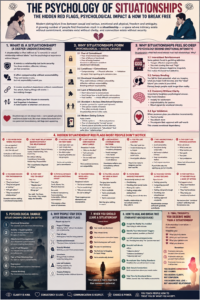
Modern dating blurs lines between casual and serious, emotional and physical, freedom and ambiguity. A growing number of people find themselves stuck in a situationship — a space where intimacy exists without commitment, emotions exist without clarity, and connection exists without security.
A situationship is an almost-relationship — emotionally charged enough to feel meaningful, but unclear enough to keep you uncertain. It is often not intentional, but psychological patterns, attachment wounds, and modern dating culture push people into these undefined emotional entanglements.
This article explores in-depth the psychology of situationships, the hidden red flags, and why so many people miss them until they’re deeply attached.
What Is a Situationship? (A Deeper Understanding)
A situationship is often described as a romantic or sexual connection without a clearly defined relationship status. But psychologically, the experience is more complex than simply “not having a label.”
A situationship can involve genuine affection, emotional intimacy, physical closeness, and even a strong sense of connection—while still lacking the clarity, consistency, mutual expectations, and emotional security that typically characterize a committed relationship.
It Mimics a Relationship but Lacks Security
You may talk every day, share personal experiences, provide emotional support, spend intimate time together, and develop strong feelings. From the outside, it can look almost identical to a relationship.
Yet internally, you may still wonder:
- What are we?
- Where do I stand in their life?
- Are we building toward something, or is this all it will ever be?
That gap between emotional closeness and relational certainty can create significant psychological tension.
It Offers Companionship Without Clear Accountability
A situationship can provide many of the emotional or practical benefits of a relationship—companionship, affection, intimacy, emotional support, and availability—without clearly establishing the responsibilities or expectations that come with commitment.
This does not automatically mean that one person is intentionally exploiting the other. Sometimes both people genuinely prefer an undefined connection. The problem arises when one person expects relationship-level emotional investment while the other avoids communicating what they are willing to offer.
It Can Create Emotional Dependence Without Commitment
As emotional intimacy increases, attachment can develop even when the relationship remains undefined.
You may begin investing more time, attention, and emotional energy while quietly hoping: “Maybe eventually this will become a real relationship.”
The difficulty is that emotional investment does not necessarily lead to commitment. You can become increasingly attached while the nature of the relationship remains exactly the same.
It Can Make You Feel Chosen in Moments but Uncertain Between Them
One of the most confusing aspects of a situationship is the contrast between intense moments of connection and periods of uncertainty.
You may feel deeply valued when they are affectionate, attentive, or emotionally available. But when that attention suddenly decreases, you may begin questioning the entire connection.
This can create a cycle of: Connection → reassurance → distance → uncertainty → overthinking → renewed connection
Over time, the unpredictability itself can become emotionally exhausting.
Not Every Situationship Is Toxic
It is important not to label every undefined relationship as unhealthy.
Some people genuinely need time to develop trust, understand compatibility, or determine whether they want a committed relationship. Two people can consciously choose a casual or undefined relationship while maintaining honest communication, mutual respect, and appropriate boundaries. The psychological concern begins when ambiguity becomes chronic, expectations become unequal, and inconsistency becomes a repeated pattern.
In other words, the problem is not necessarily the absence of a label. The deeper issue is whether both people understand what the connection means, want the same things, and feel emotionally safe within it.
When clarity repeatedly gets replaced by confusion, and emotional investment becomes increasingly one-sided, the situationship can become a source of significant psychological distress.
Why Situationship Form (Psychological + Social Causes)
Situationships rarely develop because of a single factor. They can emerge from a combination of individual psychology, attachment patterns, emotional needs, relationship skills, and the broader dating environment.
Understanding why these connections form is important because not every situationship begins with bad intentions. Sometimes two people genuinely want something casual or are uncertain about compatibility. Problems tend to arise when the two people have different expectations, different levels of emotional investment, or different ideas about where the connection is going.
1. Fear of Commitment
Some people avoid defining a relationship because commitment feels threatening or overwhelming. They may associate commitment with:
- Emotional responsibility
- Fear of rejection, failure, or heartbreak
- Loss of independence or personal freedom
- Pressure to meet relationship expectations
For some individuals, avoidant attachment tendencies may contribute to this pattern, particularly when emotional closeness is experienced as a threat to autonomy. However, avoiding commitment does not automatically mean someone has an avoidant attachment style. Personal history, previous relationships, current circumstances, and individual preferences can also play a role.
2. Loneliness and Convenience
A situationship can temporarily meet important emotional needs without requiring the vulnerability or effort associated with building a committed relationship.
It may provide:
- Companionship
- Physical affection
- Emotional comfort
- Validation
- A sense of connection
For someone who feels lonely, this arrangement can feel easier than starting over, meeting new people, or becoming emotionally vulnerable with someone unfamiliar.
The difficulty is that temporary emotional relief can sometimes keep people attached to a connection that no longer meets their deeper needs.
3. Emotional Unavailability
Emotional unavailability can also contribute to situationships. A person may want closeness while simultaneously struggling with vulnerability, emotional disclosure, or the responsibilities that come with deeper intimacy.
The pattern can look like:
Intimacy without vulnerability.
Affection without accountability.
Connection without emotional openness.
This does not necessarily mean the person does not have feelings. They may genuinely care while still lacking the emotional readiness or skills needed for a more reciprocal relationship.
4. Lack of Relationship Skills
Sometimes the problem is not avoidance—it is a lack of relational skills.
Some people have difficulty with:
- Communicating their needs clearly
- Setting and respecting boundaries
- Expressing emotions directly
- Managing conflict constructively
- Having uncomfortable conversations about expectations
- Negotiating differences in relationship goals
When these skills are weak, people may allow a relationship to remain undefined simply because having the conversation feels more difficult than avoiding it.
5. Avoidant–Anxious Attachment Dynamics
Situationships can become particularly complicated when two people have contrasting attachment-related needs.
One person may seek distance when intimacy increases, while the other may seek greater reassurance and closeness when they sense distance.
This can create a push–pull dynamic:
One person withdraws → the other pursues → the first person withdraws further → the second person becomes more anxious.
The cycle can intensify emotional preoccupation on both sides. However, it is important not to reduce every situationship to an “anxious person and an avoidant person.” Attachment patterns are only one possible explanation, and they should not be treated as fixed diagnoses or personality labels.
6. Modern Dating Culture
The contemporary dating environment can also make undefined relationships easier to enter and maintain. Dating apps and online platforms can create a sense of abundant choice, while making it easier to delay commitment, maintain multiple connections, or keep relationships loosely defined.
People may experience:
- A perception of endless alternatives
- Reduced willingness to tolerate uncertainty or incompatibility
- Fear of choosing the “wrong” person
- Greater exposure to casual dating norms
- Easier access to new potential partners
For some people, an undefined connection can therefore feel safer or more flexible than committing to a relationship before they are certain about the person.
But flexibility becomes problematic when ambiguity is being used to avoid honest communication.
Ultimately, situationships are shaped by both personal psychology and social context. Understanding the cause can provide insight, but it does not excuse patterns that repeatedly leave one person confused, emotionally neglected, or unable to communicate their needs.
Why Situationship Feel So Deep (Psychology Behind Emotional Intensity)
Situationships can sometimes feel surprisingly intense—even more emotionally consuming than some clearly defined relationships. This does not necessarily mean the connection is deeper or healthier. Often, the intensity comes from a combination of uncertainty, intermittent attention, attachment activation, fantasy, and the desire for validation.
Understanding this distinction is important: emotional intensity is not the same thing as emotional security. A relationship can feel overwhelming without providing stability, reciprocity, or genuine compatibility.
1. Intermittent Reinforcement
One reason situationships can become so psychologically compelling is intermittent reinforcement—when rewarding experiences occur unpredictably rather than consistently.
For example, someone may be intensely affectionate for several days, become distant without explanation, and then suddenly return with warmth and attention. Because the positive attention is unpredictable, you may become increasingly focused on when it will happen again.
The pattern can look like:
Attention → uncertainty → waiting → renewed attention → relief → uncertainty again
This unpredictability can strengthen persistent thoughts and checking behaviours. Variable reinforcement is a well-established learning principle, although describing every situationship as equivalent to gambling addiction would be an overstatement.
The result can still feel highly compelling: you may not simply miss the person—you may find yourself waiting for the next moment of reassurance.
2. Fantasy Bonding and the Power of Potential
When reality is unclear, the mind often fills in the missing information.
You may become attached not only to who the person actually is, but also to:
- Their potential
- Future you imagine together
- The version of the relationship you hope will develop
- Meaning you assign to small moments of affection
- The possibility that “eventually” they will choose commitment
This can create a powerful gap between the relationship you are experiencing and the relationship you are imagining.
The imagined future can become emotionally rewarding enough that walking away feels like losing not only a person, but an entire possibility.
3. Chemistry Without Clarity
Uncertainty can increase psychological arousal. When you do not know what someone feels, what will happen next, or where the relationship is going, your attention may become increasingly focused on interpreting their behaviour.
As a result, you may experience:
- Anxiety as excitement
- Unpredictability as passion
- Relief after distance as intense attraction
- Mixed signals as evidence of “chemistry”
This does not mean the attraction is necessarily fake. The chemistry may be completely genuine. The important point is that uncertainty can amplify emotional intensity, making a connection feel more significant than its actual level of stability or compatibility.
4. Ego Validation and the Need to Feel Chosen
Inconsistent attention can also affect self-esteem and the desire for validation.
When someone is warm and attentive one moment but distant the next, you may begin trying harder to regain their attention:
- You analyse their messages more closely
- Monitor changes in their behaviour
- You try to become more desirable or accommodating
- Become increasingly invested in earning their reassurance
Over time, their attention can start functioning as a form of external validation. Their interest temporarily reassures you that you are wanted, while their distance may trigger doubts about your worth.
This can create a psychologically exhausting cycle:
“If I can make them choose me, I will finally feel secure.”
But another person’s attention cannot permanently resolve insecurity or establish self-worth. When emotional validation becomes dependent on their availability, the connection can become increasingly difficult to leave—even when it is no longer meeting your needs.
Intensity Is Not the Same as Intimacy
This is one of the most important psychological distinctions to understand about situationships.
Intensity asks: “Why do I feel so strongly about this person?”
Intimacy asks: “Can we be emotionally open, consistent, reciprocal, and safe with each other?”
A situationship can produce enormous emotional intensity while offering very little relational security. Recognising that difference can help you stop interpreting anxiety, uncertainty, and longing as proof that the connection must be uniquely meaningful.
Hidden Situationship Red Flags Most People Don’t Notice
These are the subtle emotional warning signs that creep in silently and destroy your peace.
🚩 Red Flag 1: You Never Know Where You Stand
You constantly wonder:
-
“Are we together?”
-
“Do they like me?”
-
“Am I the only one?”
Confusion is NOT normal.
Confusion is communication.
A secure person will make you feel secure — not anxious.
Hidden Situationship Red Flags Most People Don’t Notice
Not every situationship is unhealthy, and not every uncomfortable behaviour is automatically a red flag. What matters is the pattern, frequency, context, and impact of the behaviour—and whether both people can communicate openly about it.
The following signs become particularly concerning when they are persistent, one-sided, and leave you repeatedly feeling confused, anxious, undervalued, or unable to express your needs.
Red Flag 2: They Want Relationship Benefits Without the Relationship
They may expect or enjoy:
- Emotional support
- Physical intimacy
- Loyalty
- Understanding
- Your time and attention
- Consistent availability
Yet they may resist offering:
- Commitment
- Mutually agreed exclusivity
- Partnership
- Shared responsibility
- Clarity about expectations
An important distinction is whether this arrangement has been mutually discussed and agreed upon. Casual relationships are not inherently exploitative. The concern arises when one person receives relationship-level benefits while deliberately avoiding the conversation about what the other person is entitled to expect.
In that situation, “keeping things casual” can become a way of avoiding accountability rather than simply expressing a relationship preference.
Red Flag 3: They Only Meet You on Their Terms
Watch for a repeated pattern of:
- Late-night meet-ups
- Last-minute plans
- Frequent cancellations
- Little effort to plan ahead
- Expecting you to remain flexible while offering little flexibility themselves
One cancelled plan means very little. A repeated pattern in which their convenience consistently determines when, where, and how you meet is more meaningful.
It may suggest that the connection is being fitted around their schedule rather than treated as a mutual priority.
Red Flag 4: They Avoid Any Conversation About Labels or Expectations
Asking for clarity is not the same as demanding a commitment.
You may reasonably ask:
- “Where is this going?”
- “Are we exclusive?”
- “What are you looking for right now?”
- “Do you see this developing into a relationship?”
If the response repeatedly becomes:
- “Why ruin the vibe?”
- “Let’s just enjoy the moment.”
- “Do we really need labels?”
- “Why are you putting pressure on this?”
the issue may not be the absence of a label—it may be the refusal to communicate about expectations at all.
Two people can choose not to use labels and still have a healthy connection if they clearly understand each other’s boundaries, expectations, and intentions.
Red Flag 5: Inconsistent Communication Patterns
Examples may include:
- Days of intense texting followed by unexplained disappearance
- Warm, affectionate messages followed by abrupt emotional distance
- Hours-long conversations followed by prolonged coldness
- Contact that increases when they want something and decreases afterward
The issue is not that someone cannot reply immediately. People have work, responsibilities, stress, and different communication styles.
The concern is persistent unpredictability that leaves you repeatedly guessing where you stand.
Consistency does not mean constant communication. It means that the person’s behaviour is reasonably predictable and aligned with what they have communicated.
Red Flag 6: You Feel Like a Secret
You may notice that they:
- Avoid introducing you to close friends
- Keep the connection hidden from important parts of their social life
- Avoid acknowledging you publicly without explanation
- Behave as though the relationship exists only in private
Not posting a partner online is not automatically a red flag. Some people value privacy or rarely use social media.
The concern becomes stronger when secrecy is combined with other patterns—such as refusing to acknowledge the connection, avoiding integration into their life, or giving contradictory explanations about why you must remain hidden.
Red Flag 7: They Are Emotionally Unavailable
Possible signs include:
- Avoiding vulnerability
- Shutting down during serious conversations
- Using humour to deflect emotional topics
- Keeping conversations superficial when emotional depth is needed
- Struggling to communicate feelings or respond to yours
Emotional intimacy requires reciprocity. If one person consistently shares, listens, and attempts to connect while the other repeatedly withdraws whenever the conversation becomes emotionally meaningful, the relationship can become deeply one-sided.
Red Flag 8: They Rarely Show Curiosity About You
Emotional investment is not measured simply by how frequently someone texts. It is also reflected in whether they show genuine curiosity about your inner world.
Do they ask about:
- What matters to you?
- scares or excites you?
- Your goals and values?
- Experiences and relationships?
- Your preferences and boundaries?
If someone consistently shows little interest in knowing you beyond attraction, convenience, or physical intimacy, it may indicate limited emotional investment.
Red Flag 9: You Constantly Make Excuses for Their Behaviour
You may hear yourself saying:
- “They’re just busy.”
- “Not good at texting.”
- “It’ll get better.”
- “They’re scared of relationships.”
- “Actually care; they just don’t know how to show it.”
Trying to understand another person’s behaviour is not inherently unhealthy. The problem begins when explanations repeatedly replace evidence and you find yourself constructing reasons to tolerate behaviour that consistently hurts you.
This can involve cognitive dissonance: holding onto the belief that someone deeply values you while repeatedly encountering behaviour that contradicts that belief.
It is also important not to automatically call this emotional manipulation. Sometimes people make excuses because they are hopeful, attached, afraid of loss, or struggling to accept an uncomfortable reality.
Red Flag 10: They Keep You “On Hold”
They repeatedly say:
- “Not now.”
- “Maybe later.”
- “Let’s see how things go.”
- “I’m not ready, but I don’t want to lose you.”
There is nothing wrong with genuinely needing time. The concern is when “maybe someday” becomes a permanent state while you continue investing emotionally.
- You wait.
- Hope.
- You invest.
- Nothing meaningfully changes.
At that point, the question becomes less about when they will be ready and more about whether the relationship you have now actually meets your needs.
Red Flag 11: Physical Intimacy Replaces Emotional Effort
They may offer:
- Touch
- Kisses
- Sex
- Physical closeness
while consistently avoiding:
- Emotional transparency
- Future-oriented conversations
- Vulnerability
- Difficult discussions
- Meaningful involvement in each other’s lives
Physical intimacy can create a powerful sense of closeness. But physical closeness and emotional intimacy are not the same thing.
When physical affection repeatedly substitutes for honest communication, it can make an emotionally uncertain connection feel more secure than it actually is.
Red Flag 12: Your Emotional Needs Are Treated as a Problem
When you express reasonable needs, they may respond with:
- “You’re too emotional.”
- “You’re overthinking.”
- “Why are you acting like we’re dating?”
- “You’re asking for too much.”
Not every request can or should be accommodated. Two people may genuinely have incompatible needs.
The red flag is repeatedly invalidating your feelings instead of discussing the underlying difference.
Healthy communication allows someone to say, “I cannot give you that,” without making you feel defective for needing it.
Red Flag 13: You Feel Jealous but Have No Clear Agreement
You may notice them:
- Liking or flirting with other people online
- Talking to multiple potential partners
- Dating other people
- Behaving in ways that make you uncomfortable
Yet you may feel unable to raise the issue because:
“We’re not official.”
This creates an important distinction: jealousy itself is not proof that someone is doing something wrong. If exclusivity has never been discussed, both people may have different assumptions about what is acceptable.
The real red flag is avoiding the conversation about boundaries while expecting emotional loyalty or exclusivity from you.
Red Flag 14: They Keep You in a “Gray Zone”
The ambiguity can become particularly problematic when it consistently benefits one person.
You may find that you are:
- Loyal
- Available
- Emotionally invested
- Providing support and companionship
while the other person avoids defining what they are willing to give in return.
The issue is not simply that the relationship is undefined. It is that the ambiguity prevents you from making informed decisions about your own emotional investment.
Red Flag 15: You’re More Anxious Than Content
You may notice:
- Constant overthinking
- Checking their social media repeatedly
- Waiting anxiously for replies
- Feeling empty or unsettled after seeing them
- Constantly wondering where you stand
Feeling anxious occasionally does not mean a relationship is unhealthy. Even secure relationships can involve uncertainty, conflict, or periods of stress.
The concern is when anxiety becomes the dominant emotional experience of the connection and the relationship repeatedly leaves you dysregulated rather than supported.
The goal is not to find a relationship that never activates difficult emotions. It is to build one where difficult emotions can be communicated, understood, and repaired.
Red Flag 16: Your Self-Esteem Slowly Declines
Over time, you may begin:
- Feeling unworthy
- Comparing yourself with other people
- Feeling that you are “not good enough”
- Doubting your attractiveness or value
- Seeking constant reassurance
A relationship does not automatically cause low self-esteem, and these experiences can have many underlying causes. But if your self-image is consistently deteriorating in response to the relationship dynamic, that impact deserves serious attention.
Red Flag 17: They Keep You as a Backup Option
You may feel like they want to keep access to you while remaining free to pursue other possibilities.
This can look like:
- Contacting you when they feel lonely
- Reappearing when other dating options do not work out
- Keeping you emotionally attached without offering clarity
- Wanting reassurance from you while continuing to explore other connections
You can become an emotional safety net rather than an equal partner in a mutually defined relationship.
Again, dating multiple people is not inherently wrong when everyone understands and agrees to that arrangement. The concern is concealing intentions or maintaining someone’s emotional investment without giving them enough information to make an informed choice.
Red Flag 18: You Are Not Growing—You Are Just Waiting
You may find yourself constantly waiting for:
- Clarity
- Commitment
- Consistency
- A change in their behaviour
- The relationship to finally “become something”
Meanwhile, your emotional life begins revolving around what might happen rather than what is actually happening.
Waiting is not automatically unhealthy. Relationships sometimes develop gradually. But if months pass with the same uncertainty and your life becomes increasingly organised around waiting for someone else’s decision, it may be time to ask:
“Am I participating in a relationship, or am I postponing my own life while hoping one will eventually begin?”
That question can reveal more than any label ever could.
Psychological Damage Situationships Can Create (In Depth)
An undefined relationship does not automatically cause psychological harm. The impact depends on factors such as duration, uncertainty, emotional investment, reciprocity, personal vulnerabilities, and how the other person responds to your needs.
However, when ambiguity and inconsistency become chronic, the emotional cost can become significant.
1. Emotional Exhaustion
Constantly trying to understand where you stand can consume considerable mental energy.
You may repeatedly analyse conversations, replay interactions, interpret changes in tone, and wonder what each behaviour means. Over time, the relationship can begin to feel less like a source of connection and more like a problem you are constantly trying to solve.
2. Anxiety and Hypervigilance
Unpredictable communication can make you increasingly alert to small changes in behaviour.
You may start monitoring:
- How quickly they reply
- Whether their messages sound different
- When they are online
- They seem distant
- Whether something has changed between you
This kind of relationship-focused hypervigilance can keep your attention locked onto possible signs of rejection or abandonment.
3. Attachment Dysregulation
When a connection repeatedly alternates between closeness and distance, your attachment system may become highly activated.
You may experience a stronger need for reassurance, increased fear of losing the person, or difficulty emotionally disengaging even when the relationship is not meeting your needs. This does not mean that situationships automatically create an attachment disorder. Rather, an inconsistent relational environment can intensify existing attachment-related sensitivities.
4. Loss of Self-Respect and Boundaries
When you become increasingly invested, you may begin accepting behaviours that you previously would not have tolerated. You might repeatedly excuse broken plans, suppress your needs, accept minimal effort, or abandon your own boundaries simply to preserve the connection.
The danger is gradual: what initially felt unacceptable can slowly start feeling normal.
5. Fear of Healthy Relationships
Repeated exposure to unpredictability can distort what emotional connection feels like.
You may begin associating:
- Uncertainty with attraction.
- Distance with mystery.
- Emotional instability with passion.
As a result, a future healthy relationship may initially feel unfamiliar or even “boring” compared with the emotional highs and lows you have become accustomed to.
This does not mean one situationship permanently damages someone’s ability to have a healthy relationship. Rather, repeated relational patterns can influence expectations about intimacy and what feels familiar.
6. Depressive Symptoms and Emotional Withdrawal
Feeling consistently unwanted, rejected, or powerless within a relationship can contribute to sadness, hopelessness, social withdrawal, and reduced self-worth in some people. However, it would be inaccurate to say that situationships directly cause clinical depression. Depression is a complex mental health condition with multiple biological, psychological, and environmental contributors.
The important point is that persistent relational distress can worsen emotional well-being and, in vulnerable individuals, may contribute to depressive symptoms.
7. Trauma Bonding: A Term That Requires Caution
The phrase “trauma bond” is often used online to describe any intense attachment formed through inconsistency, intermittent affection, or emotional highs and lows. Clinically, that usage is too broad.
Trauma bonding generally refers to a strong attachment that develops within a cycle of abuse, harm, and intermittent reinforcement, rather than simply an emotionally confusing situationship. Therefore, not every situationship involving inconsistency or intense attachment should be described as a trauma bond.
What may occur in some situationships is intermittent reinforcement and attachment activation, which can make the connection extremely difficult to leave without necessarily constituting trauma bonding.
Why People Stay Even After Seeing the Red Flags
Recognising a problem intellectually does not automatically make it emotionally easy to leave.
People can remain attached to situationships for several psychological reasons:
Hope of Change
You believe that if you are patient enough, supportive enough, or understanding enough, the relationship will eventually become what you want it to be. The focus gradually shifts from what the relationship is to what it might become.
Fear of Loss
Walking away can feel like losing not only the person but also the future you imagined with them. Sometimes people are grieving a possibility, not just a relationship.
Emotional Investment
The more time, affection, vulnerability, and energy you invest, the harder it can feel to accept that the connection may not develop further.
This is closely related to the sunk-cost effect: people may continue investing because they have already invested so much.
Scarcity Mindset
You may begin thinking: “What if I never find someone else?”
This fear can make an unsatisfying connection feel safer than the uncertainty of being alone or starting again.
Loneliness
A partially fulfilling connection can temporarily protect you from loneliness. The emotional comfort is real—even if the relationship itself is not meeting your deeper needs. That makes leaving more complicated than simply recognising that the situation is unhealthy.
Low Self-Esteem
If you already struggle with self-worth, inconsistent attention may reinforce beliefs such as:
“Maybe this is all I deserve.”
“I maybe should be grateful that they want me at all.”
These beliefs can make it harder to establish and enforce healthy boundaries.
Familiar Relationship Patterns
Some people repeatedly gravitate toward relational dynamics that feel emotionally familiar, even when those dynamics are painful.
Early family experiences can influence expectations about closeness, rejection, conflict, and emotional availability. However, this should not be simplified into “you choose unavailable people because of childhood trauma.” Human relationship patterns are shaped by many factors, and familiarity is only one possible influence.
When You Should Consider Leaving a Situationship
There is no universal deadline for ending an undefined relationship. The more useful question is whether the connection is compatible with your needs, values, boundaries, and emotional well-being.
Consider stepping away when:
- Your needs are repeatedly dismissed
- Cannot get meaningful clarity about expectations
- Your boundaries are repeatedly ignored
- You feel anxious or distressed far more often than you feel secure or content
- Self-worth is declining
- There is a persistent lack of reciprocity
- You feel as though you are begging for basic communication or consideration
- The relationship is emotionally draining without meaningful change
- You are continually waiting for a future that the other person has not actually committed to
You do not need to prove that the other person is a bad person before you are allowed to leave. A relationship can be unsuitable for you without anyone being the villain.
Your peace, boundaries, and emotional well-being matter more than the potential you see in someone.
How to Heal and Break Free from a Situationship
Healing is not about forcing yourself to stop caring overnight. It is about gradually accepting reality, reducing reinforcement of the attachment cycle, rebuilding your sense of self, and making clearer choices about future relationships.
Step 1: Accept the Reality You Have Been Avoiding
Separate what has actually happened from what you hope will happen.
Ask yourself:
- What has this person consistently shown me?
- Have they explicitly communicated?
- What am I hoping they will eventually become?
- If nothing changed, would I still choose this relationship?
Acceptance does not mean you approve of the situation. It means you stop negotiating with reality.
Step 2: Identify Your Attachment Triggers
Notice what happens emotionally when the person becomes distant.
Do you immediately fear abandonment? You pursue reassurance? Do you shut down? You become preoccupied with their behaviour?
Understanding your attachment-related triggers can help you respond more intentionally instead of reacting automatically. Attachment styles are useful frameworks for self-reflection, but they are not fixed diagnoses or excuses for unhealthy behaviour.
Step 3: Reduce Emotional Breadcrumbs
If you are trying to detach, repeatedly exposing yourself to small doses of connection can make the process harder.
Consider reducing behaviours such as:
- Checking their stories repeatedly
- Monitoring their online activity
- Re-reading old conversations
- Sending “just one more text” for reassurance
- Looking for hidden meanings in every interaction
This is not about playing games or punishing the other person. It is about creating enough psychological distance for your nervous system and attention to disengage from the cycle.
Step 4: Rebuild Self-Worth
Your value is not determined by whether one particular person chooses you.
Remind yourself:
- “I deserve clarity.”
- “I deserve consistency.”
- “My needs are valid.”
- “I do not have to earn basic respect.”
Then support those beliefs through behaviour: maintain your routines, reconnect with friends and interests, pursue meaningful goals, and keep promises you make to yourself.
Step 5: Re-Evaluate Your Dating Standards
Instead of asking only: “Do they like me?”
also ask:
- “Do I like how I feel when I am with them?”
- “Are our relationship goals compatible?”
- “Does their behaviour match what I need?”
- “Can we communicate openly?”
Healthy dating is not simply about being chosen. It is also about choosing relationships that are compatible with your values and well-being.
Step 6: Seek Secure and Reciprocal Connections
Look for relationships where communication is possible, boundaries are respected, affection is reciprocal, and uncertainty can be discussed rather than used as a permanent state.
You are not looking for someone who never makes mistakes.
You are looking for someone who can communicate, repair, take responsibility, and meet you with reasonable consistency.
Step 7: Give Yourself Time to Process and Heal
There is no universal “emotional detox” period. Healing is not a competition, and missing someone does not mean you made the wrong decision.
Useful practices may include:
- Journaling
- Talking with trusted friends
- Rebuilding routines
- Spending time away from relationship-focused social media content
- Reflecting on your patterns and boundaries
- Speaking with a qualified mental health professional if the distress is persistent or significantly affecting daily life
The goal is not to erase the relationship from your memory.
The goal is to stop allowing an uncertain relationship to determine your emotional stability.
Final Thoughts
A situationship is not necessarily a failure. Sometimes it becomes a valuable opportunity to understand yourself more clearly.
It can teach you:
- What you genuinely want from a relationship
- You are no longer willing to tolerate
- Which patterns repeatedly activate you
- Boundaries you need
- What kind of connection allows you to feel secure and respected
But learning from a situationship does not mean you have to remain in one.
Remember:
If someone wants a committed relationship with you, their intentions should eventually become understandable through both words and consistent actions. Someone values the connection, you should not have to spend months decoding whether you matter. If someone cannot offer what you need, their honesty gives you information—not a challenge you must overcome.
- You deserve commitment when commitment is what you want.
- Deserve clarity instead of chronic confusion.
- You deserve reciprocity instead of one-sided emotional labour.
- Deserve a relationship where love and respect are supported by consistent action—not merely potential.
Reference
-
APA – Relationship & Attachment Research
https://www.apa.org/monitor/2019/02/attachment -
Verywell Mind – Breadcrumbing Definition
https://www.verywellmind.com/what-is-breadcrumbing-5218333 -
Psychology Today – Avoidant Attachment
https://www.psychologytoday.com/us/basics/attachment-theory/avoidant-attachment -
Harvard Health – Emotional Health & Connection
https://www.health.harvard.edu/mind-and-mood/why-connection-matters -
National Institute of Mental Health (NIMH)
https://www.nimh.nih.gov/ - How Childhood Emotional Neglect Affects Adults: A Deep Psychological Exploration
- Contact Us
Pingback: Modern Dating Burnout: Why Gen Z Is Tired of Romance