
Introduction
Human beings are wired for connection. From the moment we are born, our emotional survival is closely connected to the quality of our earliest relationships. In particular, the bonds we form with our primary caregivers can influence how we understand safety, trust, closeness, and emotional support. Attachment Theory explains how these early bonds shape the way we love, trust, depend on others, and manage closeness throughout our lives.
Developed by John Bowlby and later expanded through the research of Mary Ainsworth, attachment theory has become one of the most influential frameworks in developmental psychology, psychotherapy, and relationship counseling. Over time, researchers and mental health professionals have used this framework to better understand how early caregiving experiences can influence emotional and relational patterns across development.
Moreover, attachment theory is not limited to childhood. The expectations and emotional patterns formed through early relationships can continue to influence how adults respond to intimacy, conflict, rejection, separation, and vulnerability. As a result, understanding attachment can provide valuable insight into behaviors that may otherwise seem confusing or difficult to change.
What Is Attachment Theory?
Attachment theory explains how early emotional bonds with caregivers shape an individual’s “internal working model”—a deeply ingrained psychological framework that influences how people perceive themselves, others, and relationships throughout life. In other words, these early experiences help children develop expectations about whether others are trustworthy, whether their needs will be met, and whether relationships feel safe.
Originally proposed by John Bowlby, the theory emphasizes that these internal working models begin to develop during infancy through repeated interactions with primary caregivers. Over time, these repeated experiences can become patterns that influence how individuals understand and respond to emotional closeness, separation, trust, and relationships. Consequently, early attachment experiences can have an important influence on relational patterns that continue into later life.
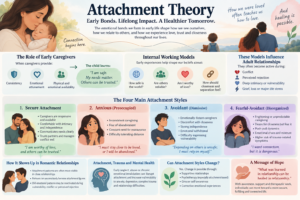
What Is an Internal Working Model?
An internal working model is not a conscious belief system. Rather, it is an emotional and relational blueprint that develops through early experiences and helps answer some of life’s most fundamental questions. In particular, these internal models influence how children understand safety, trust, self-worth, closeness, and separation.
How safe is the world?
Early caregiving experiences teach a child whether their environment is predictable and safe or threatening and uncertain. When caregivers provide consistent and responsive care, children are more likely to develop a sense of safety. On the other hand, neglect, inconsistency, or unpredictability can contribute to chronic anxiety or hypervigilance.
Are other people reliable and responsive?
When caregivers respond sensitively to a child’s needs, the child gradually learns that others can be depended on. However, when responses are inconsistent, rejecting, or frightening, the child may instead learn to expect disappointment, abandonment, or emotional danger. As a result, these early expectations can influence how the person later approaches trust and emotional dependence.
Am I worthy of love and care?
The way a child’s needs are met—or dismissed—can also shape their developing sense of self-worth. For example, attuned caregiving can support a sense of inherent worth, whereas repeated invalidation may lead to feelings of being “too much,” unimportant, or unlovable. Over time, these experiences can become part of the emotional blueprint through which a person understands their value in relationships.
How should closeness and separation feel?
Children also learn whether closeness feels comforting or overwhelming and whether separation is tolerable or terrifying. Consequently, these early experiences can influence how individuals respond to intimacy, emotional distance, conflict, and loss later in life. In this way, an internal working model can continue to shape relationship expectations even when the original caregiving environment is no longer present.
How These Models Influence Adult Relationships
These internal working models do not simply disappear as we grow older. Instead, they continue to operate quietly in the background, influencing how adults perceive relationships and respond to emotional situations, often without conscious awareness. In particular, these attachment patterns tend to become more active during emotionally charged experiences, such as:
- Romantic conflict
- Perceived rejection or abandonment
- Deep intimacy or vulnerability
- Grief, loss, or major life stress
For example, a person who learned during childhood that love was unpredictable may become anxious, clingy, or highly sensitive to changes in a partner’s behavior. Similarly, someone who learned that their emotions would be ignored may suppress their needs and avoid emotional closeness. In contrast, someone whose early relationships were frightening or unpredictable may simultaneously crave intimacy and fear it.
As a result, behaviors that appear to be “overreacting,” “emotional distance,” or “relationship insecurity” may not be reactions to the present situation alone. Instead, they can reflect the activation of an old attachment model, causing past emotional expectations to influence how a person interprets and responds to what is happening in the present.
Ultimately, recognizing this connection can help individuals understand that some relationship reactions are not simply about what is happening now; they may also be shaped by what the person learned about relationships earlier in life.
Why This Insight Is So Important
Attachment theory shifts the narrative from self-blame to self-understanding. Instead of viewing difficult relationship behaviors as personal flaws, it helps individuals recognize that many of these behaviors are learned adaptations shaped by earlier relational experiences. In other words, the way a person responds to closeness, conflict, rejection, or emotional distance may have developed as a way of protecting themselves emotionally.
Importantly, these patterns may have served a meaningful purpose during childhood, particularly when a child had to adapt to inconsistent, rejecting, frightening, or emotionally unavailable caregiving. However, a strategy that once helped someone cope may no longer be helpful in adulthood. As a result, the same protective pattern can sometimes create difficulties in intimacy, communication, trust, and emotional regulation.
In Simple Terms
But this does not mean our early experiences determine our future. Attachment theory also offers an important message of hope: patterns learned through early relationships can be understood, reshaped, and gradually healed. Through greater self-awareness, emotionally safe relationships, and appropriate therapeutic support, individuals can develop healthier ways of connecting with themselves and others.
Therefore, understanding your attachment patterns is not about labeling yourself. It is about understanding where your emotional responses may come from—and recognizing that change is possible.
The Role of Early Caregivers
Infants are biologically programmed to seek closeness to caregivers for safety, comfort, and protection. Therefore, behaviors such as crying, clinging, and following a caregiver are not simply “bad habits”; rather, they are natural attachment and survival behaviors through which infants communicate their needs.
When caregivers consistently provide:
- Consistency
- Emotional attunement
- Physical and emotional availability
the child gradually develops a sense of safety and learns: “I am safe. My needs matter. Others can be trusted.”
In contrast, when caregiving is inconsistent, rejecting, frightening, or absent, children may adapt by developing protective attachment strategies. Although these strategies can help a child cope with emotional insecurity, they may later interfere with intimacy, trust, emotional regulation, and adult relationships.
The Four Main Attachment Styles
Attachment experiences can contribute to different patterns of relating to others. Although attachment is more complex than placing people into four fixed categories, these four commonly described styles provide a useful framework for understanding differences in emotional needs, relationship behaviors, and responses to closeness.
1. Secure Attachment
Childhood Experience
- Caregivers are emotionally available and responsive
- The child feels safe exploring the environment and returning to caregivers for comfort
As a result, the child can develop confidence in both connection and exploration.
Adult Relationship Patterns
- Comfortable with intimacy and independence
- Able to communicate needs clearly
- Trusts partners and manages conflict constructively
Core Belief: “I am worthy of love, and others can be trusted.”
Overall, secure attachment is associated with healthier relationship functioning, emotional regulation, and psychological resilience.
2. Anxious (Preoccupied) Attachment
Childhood Experience
- Inconsistent caregiving
- Love and emotional availability feel unpredictable
Because of this uncertainty, the child may become highly attentive to signs of rejection or changes in a caregiver’s availability.
Adult Relationship Patterns
- Fear of abandonment
- Strong need for reassurance
- Hypervigilance to a partner’s moods
- Difficulty tolerating emotional or physical distance
Core Belief: “I must stay close to be loved, or I will be abandoned.”
Consequently, anxious attachment may appear through reassurance-seeking, people-pleasing, emotional dependency, and intense relationship anxiety.
3. Avoidant (Dismissive) Attachment
Childhood Experience
- Emotionally distant or rejecting caregivers
- Emotional needs are minimized or ignored
Over time, the child may learn that expressing emotional needs does not reliably lead to comfort or support. As a result, becoming highly self-reliant can serve as a protective strategy.
Adult Relationship Patterns
- Discomfort with excessive closeness
- Strong emphasis on independence
- Emotional withdrawal during conflict
- Difficulty expressing vulnerability
Core Belief: “Depending on others is unsafe; I must rely on myself.”
Importantly, avoidant attachment can sometimes be mistaken for confidence or emotional strength. However, apparent self-sufficiency may also function as a form of emotional self-protection.
4. Fearful-Avoidant (Disorganized) Attachment
Childhood Experience
- Caregivers may be frightening, abusive, or highly unpredictable
- The child experiences the same caregiver as both a source of comfort and a source of fear
This creates a particularly difficult attachment dilemma: the person they seek for safety may also be associated with danger. Consequently, the child may struggle to develop a consistent strategy for seeking comfort and managing distress.
Adult Relationship Patterns
- Desire for closeness combined with fear of intimacy
- Push–pull relationship dynamics
- Emotional instability and mistrust
- Increased vulnerability to trauma-related difficulties
Core Belief: “I want connection, but it is dangerous.”
Therefore, fearful-avoidant or disorganized attachment can involve a complex combination of longing for connection, fear of rejection or harm, and difficulty trusting others. These patterns may be associated with unresolved relational or traumatic experiences, although attachment style alone should not be treated as a diagnosis of trauma.
How Attachment Styles Shape Adult Romantic Relationships
Attachment patterns are often most clearly expressed in close romantic relationships because these relationships can activate the same emotional systems that developed through early caregiving experiences. In adulthood, romantic partners may unconsciously become important attachment figures, meaning that old emotional expectations can resurface—particularly during moments of uncertainty, conflict, or perceived threat.
When Attachment Patterns Become Most Visible
Attachment-related behaviors tend to become more noticeable when emotional security feels threatened. In particular, these patterns often emerge during vulnerability, conflict, or perceived separation and rejection.
1. When There Is Emotional Vulnerability
Moments of openness—such as expressing needs, sharing fears, or depending on a partner—can activate deep attachment responses. For securely attached individuals, vulnerability can create a sense of connection and emotional closeness. Those for with insecure attachment patterns, however, the same vulnerability may trigger fears of rejection, engulfment, judgment, or emotional exposure.
For example:
- Anxiously attached individuals may seek frequent reassurance and confirmation of the relationship.
- Avoidantly attached individuals may withdraw, minimize their emotions, or become uncomfortable with emotional dependence.
- Fearfully attached individuals may alternate between seeking closeness and creating distance.
Thus, the same moment of vulnerability can produce very different responses depending on a person’s attachment pattern.
2. When Conflict Arises
Conflict can signal a potential threat to connection. As a result, disagreements may activate attachment systems, making it more difficult for individuals to remain calm, reflective, and emotionally regulated.
For example:
- Anxious attachment may appear as heightened emotional expression, protest behaviors, reassurance-seeking, or fear-driven arguments.
- Avoidant attachment may appear as emotional shutdown, defensiveness, withdrawal, or avoidance of discussion.
- Secure attachment allows partners to disagree while maintaining a basic sense of relational safety.
Importantly, conflict is not necessarily harmful to a relationship. What matters is how partners interpret and respond to the conflict. For many couples, the deeper issue is not simply the topic of disagreement but whether the relationship still feels emotionally safe and secure.
3. When Separation or Rejection Is Perceived
Actual or perceived separation can strongly activate attachment fears. For instance, missed calls, delayed responses, emotional distance, changes in communication, or perceived indifference may be interpreted as signs that the relationship is becoming unsafe.
Depending on the attachment pattern:
- Anxiously attached individuals may experience intense distress and fear of abandonment.
- Avoidantly attached individuals may emotionally detach in an attempt to regain control or protect themselves.
- Fearfully attached individuals may experience confusion, mistrust, and rapidly shifting emotional responses.
Consequently, an event that appears minor from the outside can feel overwhelming when it activates deeper attachment fears or echoes earlier relational experiences.
Common Relationship Dynamics Explained
Anxious–Avoidant Dynamic: The Pursuit–Withdrawal Pattern
One of the most common and painful attachment-related relationship dynamics is the pursuit–withdrawal pattern.
Typically:
- The anxious partner seeks closeness, reassurance, and emotional engagement.
- In response, the avoidant partner may experience this intensity as pressure and begin to withdraw.
- The more one partner pursues, the more the other may withdraw, which can create a self-reinforcing cycle.
Ironically, both partners may be trying to achieve the same underlying goal: emotional safety. However, they use opposite strategies to achieve it. One moves closer to reduce insecurity, while the other creates distance to reduce emotional pressure.
Fearful Attachment: Intense and Unstable Relationships
Individuals with fearful-avoidant or disorganized attachment may crave emotional closeness while simultaneously fearing it. As a result, relationships can become characterized by conflicting needs for connection and protection.
This may lead to:
- Push–pull dynamics
- Sudden emotional shifts
- Difficulty trusting partners
- High emotional intensity followed by withdrawal
Over time, these patterns can contribute to repeated ruptures, confusion, and difficulty establishing a stable sense of emotional security.
Secure Attachment: Emotional Safety and Repair
Securely attached partners are not necessarily conflict-free. Rather, their strength lies in how they respond when difficulties arise. They tend to be repair-oriented, meaning they can work toward restoring connection after emotional ruptures.
They tend to:
- Communicate their needs openly
- Tolerate vulnerability
- Take responsibility during conflict
- Reconnect after emotional ruptures
Therefore, the key difference between secure and insecure relationship functioning is not the complete absence of conflict or emotional difficulty. Instead, it is the ability to maintain connection, communicate effectively, and repair the relationship after moments of disconnection.
Attachment Theory in Counseling and Psychotherapy
Attachment theory provides mental health professionals with a useful framework for understanding how early relational experiences may continue to influence emotional and interpersonal functioning in adulthood. By examining attachment patterns, therapists can better understand the emotional needs, fears, and relationship strategies that may underlie a client’s difficulties.
Mental health professionals may use attachment theory to:
- Understand recurring relationship patterns
- Address fears of abandonment or intimacy
- Explore and process childhood emotional wounds
- Improve emotional regulation
- Strengthen relational security
Furthermore, attachment-based concepts have been integrated into several therapeutic approaches, including:
- Psychodynamic therapy
- Emotionally Focused Therapy (EFT)
- Trauma-informed approaches
Through these approaches, therapy can help individuals recognize recurring attachment patterns, understand the experiences that shaped them, and develop healthier ways of responding to emotional needs and relationships.
Why Attachment Theory Matters
Attachment theory helps shift the focus from self-blame toward self-understanding. Rather than viewing relationship struggles as evidence of personal defects, it reframes many difficulties as learned relational patterns that developed through earlier experiences.
In this way, attachment theory can help individuals explore important questions such as:
- Why do I fear closeness?
- I chase unavailable partners why?
- Why does intimacy feel overwhelming or unsafe?
These questions can reveal the emotional needs and fears beneath seemingly confusing relationship behaviors. More importantly, understanding these patterns can create an opportunity for change rather than simply repeating them.
And perhaps the most hopeful message of attachment theory is: “What was learned in relationship can be healed in relationship.”
This does not mean that every relational difficulty originates in childhood or that relationships alone can resolve psychological problems. Rather, it highlights the potential for new, safe, and consistent relational experiences to support healthier patterns of connection.
Final Reflection
Attachment theory reminds us that love is not simply an emotion—it is also a developmental experience. Our earliest relationships can influence how we connect with others, protect ourselves, seek comfort, and respond to emotional closeness. Nevertheless, these early experiences do not have to determine our future.
With greater awareness, supportive relationships, and appropriate therapeutic work, individuals can gradually develop more secure ways of relating. Over time, this process may contribute to what is often described as earned secure attachment—a greater capacity to experience trust, emotional safety, intimacy, and healthy independence across adult relationships.
Frequently Asked Questions (FAQ): Attachment Theory & Adult Relationships
1. What is attachment theory?
Attachment theory explains how early emotional bonds with caregivers shape our expectations of safety, closeness, and trust in relationships. It was developed by John Bowlby and expanded through research by Mary Ainsworth.
2. What is an “internal working model”?
An internal working model is a mental–emotional blueprint formed in childhood that influences:
- How safe the world feels
- Whether others can be trusted
- How worthy we feel of love
- We experience closeness and separation how
These models guide adult relationship behavior, often outside conscious awareness.
3. What are the main attachment styles?
The four commonly described attachment styles are:
- Secure – comfortable with intimacy and independence
- Anxious (Preoccupied) – fears abandonment, seeks reassurance
- Avoidant (Dismissive) – values independence, avoids vulnerability
- Fearful-Avoidant (Disorganized) – desires closeness but fears it
4. How do attachment styles affect adult romantic relationships?
Attachment styles influence how people:
- Communicate needs
- Handle conflict
- Respond to emotional closeness
- React to distance or rejection
For example, anxious partners may pursue reassurance, while avoidant partners may withdraw, creating a pursue–withdraw cycle.
5. Why do small conflicts feel so intense in some relationships?
Because conflicts often activate old attachment fears, such as abandonment, rejection, or loss of control. The emotional reaction may be less about the present issue and more about earlier relational experiences being triggered.
6. Can attachment styles change over time?
Yes. Attachment styles are not fixed traits. They can shift through:
- Secure and emotionally responsive relationships
- Psychotherapy (especially attachment-based or trauma-informed therapy)
- Increased self-awareness and emotional regulation skills
Many adults develop what is called earned secure attachment.
7. Is insecure attachment a sign of weakness?
No. Insecure attachment patterns are adaptive survival strategies learned in response to early environments. They helped individuals cope emotionally at the time, even if they create difficulties later.
8. How is attachment theory used in therapy?
Therapists use attachment theory to:
- Understand relationship patterns
- Address fear of abandonment or intimacy
- Improve emotional regulation
- Heal childhood emotional wounds
It is commonly integrated into psychodynamic therapy, Emotionally Focused Therapy (EFT), and trauma-informed care.
9. Does attachment theory apply only to romantic relationships?
No. Attachment patterns influence all close relationships, including friendships, parent–child bonds, and even therapeutic relationships. Romantic partnerships simply activate attachment systems more strongly.
10. What is the key message of attachment theory?
The central message is hopeful:
How we learned to love can be relearned.
Early relationships shape us, but they do not define our future. With awareness, safety, and support, healthier patterns of connection are always possible.
Reference
-
What Is Attachment Theory? — Verywell Mind
A clear summary explaining how early bonding impacts lifelong emotional health and relationships. Attachment Theory Explained (Verywell Mind) -
John Bowlby’s Attachment Theory — Simply Psychology
A detailed explanation of Bowlby’s foundational ideas about attachment and caregiver influence. John Bowlby’s Attachment Theory (Simply Psychology) -
Attachment Theory Background & Concepts — PositivePsychology.com
A modern synthesis of attachment theory and its core principles include caregiver responsiveness and long-term effects. Attachment Theory Overview (PositivePsychology.com) -
Attachment in Adults (Extension of the Theory) — Wikipedia
Explains how attachment theory has been expanded to understand adult romantic and close relationships. Attachment in Adults (Wikipedia) - Erikson’s Psychosocial Stages Across the Lifespan: A Deep Exploration
Pingback: Piaget’s Cognitive Development Theory Explained with Example
Pingback: Signs You Are Emotionally Unavailable (Even If You Care)
Pingback: How Childhood Trauma Affect Adult Life (Inner child healing)
Pingback: Piaget’s Cognitive Development Theory: 4 Stages Explained with Examples – MonoProva Healing