
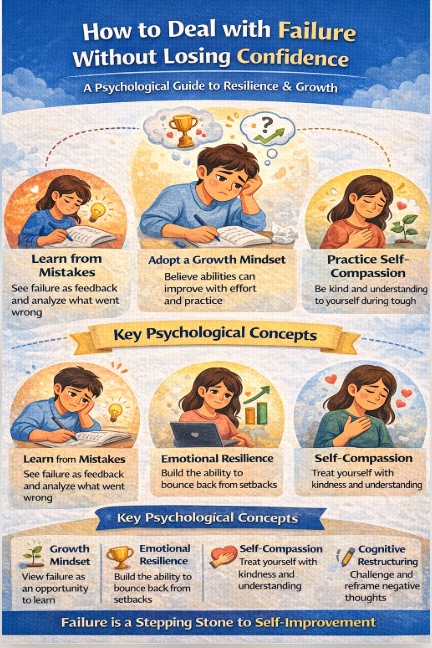
Tired of needing sympathy after every setback? Discover psychological tools to turn failure into confidence and real growth.
Introduction
Failure is an inevitable part of life. Whether it’s not getting a job, failing an exam, facing rejection in relationships, or making a mistake at work—everyone experiences failure at some point. Yet, what differentiates successful individuals from others is not the absence of failure, but how they respond to it.
For many, failure leads to self-doubt, low self-esteem, and fear of trying again. But from a psychological perspective, failure can also be a powerful catalyst for growth, resilience, and self-discovery.
This article explores how to deal with failure without losing confidence, using key psychological concepts such as growth mindset, self-efficacy, cognitive restructuring, emotional regulation, and resilience, along with practical strategies and real-life examples.
Understanding Failure: A Psychological Perspective
Failure is not just an event—it’s how we appraise and emotionally respond to that event. Cognitive appraisal theory (Lazarus) says our reaction depends on two key evaluations: primary appraisal (is this situation harmful, threatening, or irrelevant?) and secondary appraisal (do I have the resources to cope?). Those appraisals shape emotions, motivation, and behavior after failure.
Why two people respond differently
Appraisal differences:
- Threat vs. challenge: If someone appraises failure as a threat to self-worth, they feel shame and withdrawal. If they see it as a challenge or learning opportunity, they feel motivated and curious.
- Controllability judgments: Believing the causes are controllable (effort, strategy) promotes problem-focused coping. Believing causes are stable and uncontrollable (ability, fate) promotes helplessness.
Attributional style (Weiner, Abramson): How people explain causes matters. An internal, stable, global attribution (“I’m bad at everything”) leads to hopelessness. An external, unstable, specific attribution (“I didn’t prepare enough this time”) supports corrective action.
Self-efficacy and perceived competence (Bandura): Higher self-efficacy buffers the negative impact of failure—people with strong efficacy view setbacks as information, not verdicts.
Emotion regulation capacity: People with better emotion regulation (reappraisal, problem-solving, self-soothing) recover faster and are less likely to ruminate.
Mindset (Dweck): A fixed mindset interprets failure as reflecting immutable traits; a growth mindset views failure as feedback for improvement.
Cognitive distortions and rumination: Overgeneralization, catastrophizing, and persistent rumination prolong negative affect and reduce motivation to try again.
Social and cultural context: Social feedback, norms about failure, and stigma influence appraisal. Supportive environments promote adaptive appraisals; shame-based contexts encourage avoidance.
Neurocognitive factors: Stress from failure can activate the amygdala and impair prefrontal executive functioning, making flexible thinking and problem-solving harder—especially when people lack stress-management skills.
Illustrative example revisited
Two students fail an exam. Student A interprets failure as “I’m not smart” (internal, stable, global), experiences shame, ruminates, and stops trying—classic learned helplessness. Student B views the result as “My study method didn’t work” (internal, unstable, specific), thinks “I can change my approach,” seeks feedback, practices strategically, and improves next time.
Practical implications
Interventions that change appraisals help: cognitive restructuring to challenge global/stable attributions, building self-efficacy through mastery experiences, teaching reappraisal and problem-focused coping, and fostering a growth mindset.
Short-term support: Normalize the emotion, label it, and reframe failure as information rather than identity.
Behavioral steps: Break failures into specific causes, set small corrective goals, and track progress to shift appraisals from helplessness to agency.
The Role of Self-Efficacy
Self-efficacy, a concept introduced by Albert Bandura, is the conviction in one’s capability to organize and execute the courses of action required to produce given attainments. It shapes how people think, feel, motivate themselves, and behave. Individuals with high self-efficacy typically:
- Interpret failure as temporary and specific rather than global and permanent (attributional style).
- Hold an incremental mindset (growth mindset), believing abilities can improve through effort and learning.
- Show greater persistence and resilience in the face of setbacks (adaptive coping and psychological hardiness).
- Exhibit higher intrinsic motivation and goal-directed behavior due to positive outcome expectancies and stronger self-regulation.
Psychological mechanisms that support self-efficacy include:
- Mastery experiences: past successes that build confidence.
- Vicarious learning: observing others succeed (social modeling).
- Social persuasion: encouragement from others that bolsters belief.
- Physiological and affective states: interpreting arousal and anxiety in ways that either undermine or enhance self-belief.
Example: An entrepreneur whose startup fails may interpret that setback as a specific, controllable event (attribution), use lessons learned as mastery experiences, and maintain a growth mindset. These processes sustain their self-efficacy, which promotes resilience, adaptive problem-solving, and renewed effort on future ventures.
Growth Mindset vs Fixed Mindset
Psychologist Carol Dweck introduced the mindset framework distinguishing beliefs about intelligence and ability.
Fixed mindset
- Belief: Intelligence and abilities are innate, stable traits (entity theory).
- Typical response to failure: “I failed, so I’m not capable.” This promotes a negative attributional style (internal, stable, global).
- Behavior: Avoids challenges, shows performance-avoidance goals, and experiences learned helplessness when faced with setbacks.
- Emotional/ motivational effects: Higher anxiety about evaluation, reduced persistence, and reliance on performance goals to validate self-worth.
Growth mindset
- Belief: Intelligence and abilities can be developed through effort and effective strategies (incremental theory).
- Typical response to failure: “Failure is part of learning.” This supports adaptive attributions (controllable, specific, temporary).
- Behavior: Embraces challenges, adopts mastery-oriented goals, and uses metacognitive strategies to improve.
- Emotional/ motivational effects: Greater resilience, persistence, intrinsic motivation, and use of self-regulation (goal-setting, planning, monitoring).
Psychological mechanisms
- Attribution theory: How people explain outcomes shapes future motivation.
- Goal orientation: Mastery (learning) vs performance (proving) goals drive responses to tasks.
- Self-regulation and metacognition: Growth mindset fosters strategic learning, monitoring progress, and adjusting approaches.
- Stereotype threat interactions: Fixed-mindset beliefs can amplify vulnerability to stereotype threat in evaluative situations.
Example: A student with a fixed mindset may stop trying after a poor exam grade, attributing it to lack of ability (internal, stable). A student with a growth mindset will view the grade as feedback, set specific learning goals, use study strategies, and seek feedback—showing adaptive coping and persistence.
Emotional Response to Failure
Failure often triggers strong emotional reactions such as shame, guilt, anxiety, and frustration. These affective states are generated and processed through emotion systems of the brain and by cognitive appraisal processes:
- Neurobiology: The limbic system (especially the amygdala) detects threat and salient negative events and activates fast emotional responses. The anterior cingulate cortex (ACC) signals conflict and distress, and the insula registers subjective feelings (e.g., disgust, pain). Prefrontal cortical regions (ventromedial and dorsolateral PFC) are involved in regulating these responses through cognitive reappraisal and inhibitory control.
- Cognitive appraisal: How a person interprets failure—its cause, controllability, and scope—shapes emotional intensity (based on appraisal theory). Attributions that are internal, stable, and global increase shame and hopelessness; attributions that are specific, unstable, and controllable reduce emotional severity.
Common maladaptive responses:
- Negative self-talk (rumination): repetitive, self-critical thought loops that amplify distress and impair problem solving.
- Avoidance behavior: withdrawal from tasks or challenges to reduce immediate distress, which reinforces fear and reduces mastery experiences.
- Reduced motivation: drop in intrinsic motivation and shift toward performance-avoidance goals, lowering persistence.
Regulation strategies (brief):
- Cognitive reappraisal: reinterpret failure as feedback and learning opportunity to reduce negative affect.
- Mindfulness and acceptance: observe emotions without overidentifying, reducing rumination.
- Problem-focused coping: set specific, achievable next steps to restore a sense of control and build mastery.
- Social support and self-compassion: external perspective and kinder self-evaluation lower shame and encourage adaptive behavior.
Example: After a failed presentation, the amygdala and ACC activate, producing anxiety and shame. If the person ruminates (“I’m worthless”), they may avoid future presentations. If they instead reappraise the failure as a rehearsal opportunity, seek feedback, and practice specific skills, prefrontal regulation strengthens, negative affect decreases, and motivation returns.
Failure often activates cognitive distortions—biased, automatic thinking patterns that amplify negative emotions and erode confidence. Common distortions after failure include:
Overgeneralization:
Drawing broad conclusions from a single event. Example: “I failed this interview, so I’ll always fail.” Leads to hopelessness and reduced approach behavior.
All-or-Nothing (black-and-white) thinking:
Viewing outcomes in extremes with no middle ground. Example: “If I’m not perfect, I’m a failure.” Encourages avoidance of challenge and fear of making mistakes.
Labeling:
Assigning a global negative identity based on one episode. Example: “I’m a loser.” Fuels low self-esteem and self-stigma.
Mental Filter (selective abstraction):
Focusing only on negative details while ignoring positives. Example: Fixating on one critical comment despite overall praise.
Catastrophizing:
Expecting the worst possible outcome and magnifying its likelihood. Example: “This rejection ruins my career.”
Personalization:
Taking excessive personal responsibility for events beyond one’s control. Example: “They rejected me because I’m incompetent” when external factors mattered.
Emotional Reasoning: Believing feelings reflect facts. Example: “I feel incapable, so I must be incapable.”
Brief corrective strategies (CBT-based):
- Cognitive restructuring: Identify the distortion, gather evidence for and against the thought, then create a balanced alternative (e.g., “One rejection doesn’t predict all future outcomes”).
- Behavioral experiments: Test beliefs with planned actions (apply to another role, rehearse interview answers) to generate disconfirming evidence.
- Decatastrophizing: Estimate the realistic consequences, probability, and coping resources to reduce catastrophic appraisals.
- Thought-record: Track automatic thoughts, associated emotions, evidence, and alternative interpretations to weaken distorted patterns.
- Self-compassion exercises: Replace harsh labels with kinder, factual self-statements to reduce shame-driven thinking.
Example: After a job rejection, instead of thinking “I’ll never get a job” (overgeneralization), use cognitive restructuring: list evidence (past successes, skills), note external factors (fit, timing), and form a balanced thought (“This role wasn’t the right fit; I have strengths that will match other opportunities”).
Cognitive Restructuring: Changing Thought Patterns
Cognitive restructuring is a core CBT technique that helps people identify, evaluate, and change distorted automatic thoughts that cause distress and maladaptive behavior. It targets the cognitive level (automatic thoughts and underlying schemas) to produce emotional and behavioral change.
Step-by-step technique
- Notice the automatic thought. Record the situation, the immediate thought, and the emotion (with intensity 0–100%).
- Identify the cognitive distortion(s). Label patterns such as overgeneralization, catastrophizing, personalization, or all-or-nothing thinking.
- Evaluate the evidence. List facts that support and contradict the automatic thought. Ask: What’s the objective evidence? Are there alternative explanations? How would I advise a friend?
- Generate balanced alternative thoughts. Create realistic, specific, and proportional appraisals that acknowledge facts and controllable steps (avoid vague positivity).
- Test with behavior. Plan a small, concrete action (behavioral experiment) to gather new evidence and update beliefs.
- Review and reinforce. After the experiment, note what changed in evidence, emotion, and future thinking. Repeat until the balanced thought becomes more automatic.
Practical tips
- Use written thought records to slow down and objectify thinking.
- Focus on specific, testable beliefs rather than global self-evaluations.
- Keep alternatives behavior-linked: include an action or coping plan to strengthen learning.
- Use Socratic questioning: “What’s the worst that could happen? How likely is that? What can I do if it happens?”
- Pair restructuring with emotion regulation (deep breathing, grounding) when intensity is high so prefrontal evaluation can work effectively.
Example
- Situation: Received critical feedback on a project.
- Automatic thought: “I failed because I’m useless.” Emotion: shame/anxiety (85%).
- Distortions: Labeling, overgeneralization.
- Evidence for: I made errors in the report.
- Evidence against: I completed the project on time, received positive comments on earlier work, others have faced similar critiques. External factors (tight deadline) contributed.
- Balanced thought: “This project had problems I can fix. I’ve done good work before and can learn from this feedback to improve.” Emotion after (estimate): shame/anxiety (35%).
- Behavioral experiment: Revise the report addressing feedback, ask a colleague for review, and submit an improved version.
Building Emotional Resilience
Resilience is the capacity to adapt, recover, and grow after adversity. Psychologically, it’s not a fixed trait but a dynamic process involving cognition, emotion, behavior, and social context.
Core components and psychological mechanisms
1. Emotional regulation:
The ability to monitor, evaluate, and modulate emotional responses. Neurobiologically, effective regulation engages prefrontal regions (dorsolateral and ventromedial PFC) to downregulate limbic activity (amygdala). Skills include cognitive reappraisal, grounding, and acceptance, which reduce physiological arousal and improve problem-focused action.
2. Optimism and positive appraisal:
An explanatory style that emphasizes controllable, specific, and temporary causes (adaptive attributions). Optimism supports positive outcome expectancies and persistence via increased approach motivation and dopamine-mediated reward learning.
3. Problem-solving skills:
Active coping that breaks problems into manageable steps, uses goal-setting and planning, and therefore increases perceived control (locus of control) and self-efficacy. Problem-solving therapy and behavioral activation strengthen these skills.
4. Cognitive flexibility:
The capacity to shift perspectives and generate alternative interpretations and strategies. It reduces rigid maladaptive schemas and promotes creative coping (related to executive function and set-shifting).
5. Social support and connectedness:
Emotional, informational, and instrumental support buffer stress (social buffering hypothesis), reduce perceived threat, and provide resources for coping. Secure attachment histories predict better stress regulation and resilience.
6. Meaning-making and post-traumatic growth:
Constructing a coherent narrative and finding purpose can transform adversity into growth, enhancing well-being and long-term adaptation.
7. Physiological regulation and stress recovery:
Healthy sleep, exercise, and relaxation practices improve autonomic balance (parasympathetic activity), cortisol regulation, and resilience to future stressors.
Brief practical strategies to build resilience
1. Practice cognitive reappraisal:
Reframe setbacks as learning opportunities and identify what is controllable. (CBT-based)
2. Build mastery with graded exposure:
Create small, achievable goals to accumulate mastery experiences and boost self-efficacy.
3. Strengthen social ties:
Seek supportive relationships, share setbacks, and ask for specific help or feedback.
4. Develop problem-focused routines:
Use structured problem-solving steps: define problem, generate options, choose one, act, review.
5. Train emotion regulation:
Learn mindfulness, diaphragmatic breathing, and brief grounding techniques to lower reactivity during stress.
6. Foster optimism intentionally:
Keep a “three good things” or gratitude practice to bias attention toward positive outcomes and reinforce reward circuits.
7. Take care of the body:
Prioritize sleep, regular aerobic exercise, and balanced nutrition to support cognitive and emotional resources.
8. Narrative reframing:
Write or talk about the event with an emphasis on lessons learned and future goals to promote meaning-making.
Example: A person loses a job (stressful life event). By using problem-solving (update CV, learn a new skill), applying cognitive reappraisal (“This setback lets me pivot to a better fit”), seeking network support (informational leads), and practicing calming techniques during interviews, they maintain motivation, increase self-efficacy, and ultimately transition into a new role—demonstrating psychological resilience and potential post-traumatic growth.
The Role of Self-Compassion
Self-compassion—defined and popularized by Kristin Neff—is the tendency to treat oneself with the same kindness, understanding, and care one would offer a good friend when facing pain, failure, or inadequacy. It reliably predicts better emotional recovery, lower shame, and greater motivation after setbacks.
Three components (Neff)
- Self‑kindness: Responding to suffering with warmth and gentle encouragement rather than harsh self‑criticism. Encourages soothing emotions and reduces self‑punitive behaviors.
- Common humanity: Recognizing that failure and imperfection are part of the shared human experience, which reduces isolation and shame by reframing the event as normal rather than uniquely catastrophic.
- Mindfulness: Observing painful thoughts and feelings with balanced awareness (not overidentifying or suppressing them), which prevents rumination and supports clearer cognitive processing.
Psychological mechanisms
- Emotion regulation: Self‑compassion activates self‑soothing systems (parasympathetic response) and downregulates threat responses, lowering cortisol and physiological reactivity to stress.
- Reduced self‑criticism and shame: By replacing punitive inner dialogue, self‑compassion reduces shame-based avoidance and promotes approach behaviors.
- Increased motivation and adaptive goal pursuit: Contrary to the belief that kindness undermines drive, self‑compassion fosters realistic self‑evaluation and constructive feedback, which supports learning and persistence (healthy self‑regulation).
- Buffering social threat: Common‑humanity reframing reduces perceived social isolation and increases willingness to seek support.
- Neurobiology: Practices that increase self‑compassion engage brain regions involved in affiliation and reward (ventral striatum, medial prefrontal cortex) and reduce activity in areas linked to threat (amygdala).
Short practices to cultivate self‑compassion which can helps you to dealing with failure
- Self‑compassion break (Neff): Brief sequence—1) Acknowledge the suffering (“This is hard right now”), 2) Remind yourself of common humanity (“Others struggle too”), 3) Offer a compassionate phrase (“May I be kind to myself”), paired with soothing touch (hand on heart).
- Compassionate letter: Write to yourself from the perspective of a compassionate friend describing the situation, your strengths, and next steps.
- Soothing breathing: Slow diaphragmatic breathing for 2–5 minutes while repeating a kind phrase to reduce physiological arousal.
- Reframe self‑talk: When a harsh thought appears, label it (“That’s my inner critic”), then replace it with a balanced, caring statement (acknowledge the mistake, offer encouragement, note a next step).
- Behavioral self‑care plan: List small, concrete acts of care you will do after a setback (rest, nutritious meal, short walk, call a friend).
Example: Instead of thinking “I failed; I’m worthless,” a self‑compassionate response would be: “This hurts, and it’s understandable to feel upset. Many people fail and learn from it. I’ll be kind to myself now and take one step to improve.” This reduces shame, stabilizes mood, and increases likelihood of constructive action.
Attribution Theory: How We Explain Failure
Attribution theory (Heider; expanded by Weiner) examines how people explain the causes of events—successes and failures—and how those explanations influence emotions, expectations, and behavior. Attributions are typically described along three dimensions:
- Locus: internal (personal) vs external (situational). Example: “I didn’t study enough” (internal) vs “The test was unfair” (external).
- Stability: stable vs unstable. Example: “I’m not smart” (stable) vs “I was tired that day” (unstable).
- Controllability: controllable vs uncontrollable. Example: “I can improve my study strategy” (controllable) vs “Bad luck” (uncontrollable).
Healthy (adaptive) attributional patterns
- Attribute failure to factors that are internal, unstable, and controllable (effort, strategy, preparation). This fosters a growth orientation, preserves motivation, and promotes approach coping and problem‑solving. It increases perceived self‑efficacy because the person believes their actions can change outcomes.
- Attribute success to internal, stable (ability) and controllable factors appropriately (recognizing both skill and effort), which supports realistic confidence and reinforces effective behaviors.
Unhealthy (maladaptive) attributional patterns
- Internal, stable, uncontrollable attributions for failure (e.g., “I’m not smart”) produce helplessness, decreased motivation, and avoidance (learned helplessness in extreme cases). They also increase negative emotions like shame and hopelessness.
- Overemphasis on external, unstable attributions for success (e.g., “I succeeded because I got lucky”) can undermine confidence and reduce persistence.
Emotional and behavioral consequences
- Attributions shape emotional responses: internal-stable causes increase shame and lowered self-esteem; external-unstable causes may evoke anger or blame; internal-controllable causes elicit guilt that can motivate reparative action.
- Attributions influence goal orientation: controllable attributions align with mastery goals and adaptive self-regulation; uncontrollable attributions promote performance-avoidance and disengagement.
- Cognitive interventions (CBT, attributional retraining): can shift maladaptive attributions toward more adaptive ones, improving effort, persistence, and achievement.
Brief intervention ideas
- Attributional retraining: Teach people to reinterpret setbacks as due to controllable, specific factors and to plan concrete actions (study plan, strategy change).
- Socratic questioning: Challenge stable/global beliefs (“Always? Really?”), gather counter-evidence, and generate alternative explanations.
- Behavioral experiments: Test whether changing behavior (e.g., study method) improves outcomes, providing disconfirming evidence for fixed attributions.
- Promote incremental theory: Combine with growth-mindset training to reinforce the belief that abilities can develop.
Example: A student fails an exam. Adaptive attribution: “I didn’t prepare effectively this time; I can change my study strategy and improve” (internal, unstable, controllable). This leads to planful behavior (new study schedule), higher self-efficacy, and likely better performance next time. Maladaptive attribution: “I’m just not smart” (internal, stable, uncontrollable). This leads to demotivation, avoidance of studying, and poorer future outcomes.
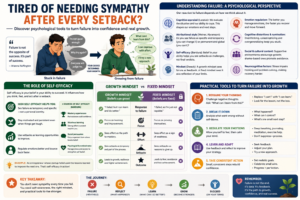
Behavioral Strategies to Maintain Confidence: Dealing with Failure
Failure can feel disorienting and damaging to confidence, but it also offers clear opportunities for learning and growth. The following behavioral strategies translate psychological principles into practical steps you can use to maintain and rebuild confidence after setbacks.
Break the failure down (functional analysis)
- What to do: Decompose the event into specific factors—skills, knowledge gaps, situational constraints, timing, resources, and controllable vs uncontrollable elements.
- Why it helps: Reduces overgeneralization and labeling by producing specific, testable causes (supports accurate attributions and problem‑solving). It converts vague global beliefs into actionable items, increasing perceived control and self‑efficacy.
Focus on process, not outcome (process orientation / mastery goal)
- What to do: Track effort, strategies used, study behaviors, and learning gains rather than only final results.
- Why it helps: Encourages mastery goals over performance goals, lowers performance anxiety, and promotes adaptive self‑regulation and metacognition. Reinforces incremental beliefs and supports long‑term improvement.
Set realistic goals (SMART + graded exposure)
- What to do: Create Specific, Measurable, Achievable, Relevant, Time‑bound steps; use graded exposure to increase challenge gradually.
- Why it helps: Prevents all‑or‑nothing thinking and perfectionism, builds mastery experiences (Bandura), and steadily raises self‑efficacy through achievable successes.
Take action quickly (behavioral activation)
- What to do: Identify one small concrete step to take within 24–48 hours (revise, rehearse, ask for feedback, apply again).
- Why it helps: Reduces avoidance and rumination, interrupts learned helplessness cycles, and produces corrective feedback via behavioral experiments—essential for updating beliefs.
Celebrate small wins (reinforcement and positive feedback) which helps you to dealing with Failure
- What to do: Explicitly acknowledge and record small improvements and successful steps (daily log, “three small wins” list).
- Why it helps: Activates reward systems (dopamine), strengthens approach motivation, counters negativity bias and mental filtering, and consolidates new adaptive behavior through positive reinforcement.
Brief integration tips
- Combine strategies: After breaking the failure down, set a SMART small goal, take one quick action, and record the outcome as a small win.
- Use written tools: Thought records, behavioral experiments logs, and a small‑wins journal increase clarity and make progress visible.
- Pair with emotion regulation: Use brief grounding or breathing before action when anxiety is high so cognitive control supports adaptive planning.
- Socialize the plan: Share goals with a supportive person for accountability and social reinforcement.
Example
A rejected grant application:
- Break it down: feedback cited weak pilot data and unclear methods.
- Process focus: list steps for improving methods and data collection.
- Realistic goals: SMART step—complete one pilot experiment in 3 weeks.
- Quick action: email a potential collaborator today to discuss methods.
- Celebrate: log completion of the pilot and share the progress with a mentor.
The Role of Neuroplasticity: Dealing with Failure
The brain has the ability to change and adapt—this is called neuroplasticity.
Failure can actually strengthen neural pathways related to learning.
Example: Repeated practice after failure improves performance by reinforcing new neural connections.
Social Support and Confidence: Dealing with Failure
Support from others plays a crucial role.
Types of Support:
- Emotional support
- Informational support
- Motivational encouragement
Example: A friend encouraging you after failure can help restore confidence.
Real-Life Case Example
Consider “Rahul,” a young professional.
Rahul failed an important job interview. Initially, he felt:
- Low self-esteem
- Anxiety
- Fear of future interviews
Through self-reflection, he realized:
- He lacked preparation
- His communication skills needed improvement
He practiced, improved his skills, and succeeded in the next interview.
Rahul’s journey shows how self-efficacy, cognitive restructuring, and resilience can transform failure into success.
Avoiding learned helplessness after failure
Repeated failure can lead to learned helplessness, where individuals feel powerless.
Signs:
- Giving up easily
- Lack of motivation
- Negative expectations
Solution:
- Build small successes
- Regain sense of control
- Challenge negative beliefs
Mindfulness and emotional regulation in response to failure
Mindfulness helps individuals observe emotions without judgment.
Benefits:
- Reduces emotional reactivity
- Improves focus
- Enhances self-awareness
Example: Instead of reacting impulsively to failure, pause and observe your thoughts.
Long-Term Impact of Healthy Failure Processing
When handled well, failure leads to:
- Increased resilience
- Better decision-making
- Stronger self-confidence
- Personal growth
Conclusion
Failure is not the opposite of success—it is a part of it. From a psychological perspective, the way we interpret and respond to failure determines whether it becomes a setback or a stepping stone.
By applying concepts such as growth mindset, self-efficacy, cognitive restructuring, emotional regulation, and resilience, individuals can transform failure into an opportunity for growth.
Confidence is not built by avoiding failure, but by learning to face it, understand it, and rise above it.
In the end, failure does not define you—your response to it does.
Frequently Asked Questions (FAQs)
1. Why does failure affect confidence?
Failure can trigger negative thoughts, self-doubt, and emotional distress, affecting self-esteem.
2. What is a growth mindset?
A growth mindset is the belief that abilities can improve through effort and learning.
3. How can I stay confident after failure?
By reframing thoughts, focusing on learning, and taking small steps forward.
4. What is self-efficacy?
It is the belief in your ability to succeed in specific situations.
5. Can failure be beneficial?
Yes. It helps build resilience, learning, and personal growth.
6. What are cognitive distortions after failure?
Negative thinking patterns like “I always fail” or “I’m not good enough.”
7. How can I stop negative thinking after failure?
Use cognitive restructuring and challenge irrational thoughts.
8. What is learned helplessness?
A state where repeated failure makes a person feel powerless and give up.
9. How does resilience help after failure?
It helps you bounce back and adapt to challenges.
10. When should I seek help?
If failure leads to prolonged anxiety, depression, or loss of motivation.
References
American Psychological Association. (n.d.). Resilience and coping. https://www.apa.org
National Institute of Mental Health. (n.d.). Mental health and coping strategies. https://www.nimh.nih.gov
Monoprova Counselling, (2026), “About Us”,
Monoprova Counselling, (2026), “Contact Us”,
This article is written for knowledge purposes, aiming to help readers understand the topic better and gain useful insights for learning and awareness.
Pingback: B.F. Skinner Behavioral Theory: Conditioning Reinforcement