
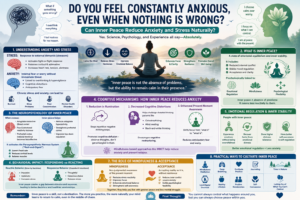
“Do you feel constantly anxious, even when nothing is wrong?”
Introduction
In today’s fast-paced world, anxiety and stress have become almost universal experiences. From academic pressure and career uncertainty to relationship struggles and digital overload, the human mind is constantly navigating perceived threats. Amid this, the concept of inner peace is often presented as a solution—but can it truly reduce anxiety and stress naturally? From a psychological standpoint, the answer is yes, and the mechanisms behind it are both profound and evidence-based.
Understanding Anxiety and Stress: A Psychological Foundation
Before exploring inner peace, it is important to understand what anxiety and stress actually are.
Stress is a physiological and psychological response to external demands (stressors). It activates the sympathetic nervous system, triggering the fight-or-flight response. This leads to the release of stress hormones like cortisol and adrenaline, increasing heart rate, alertness, and muscle tension.
Anxiety, on the other hand, is more internal. It involves persistent worry, fear, or apprehension, often without an immediate external threat. Psychologically, anxiety is linked to:
- Cognitive distortions (e.g., catastrophizing, overgeneralization)
- Hypervigilance
- Anticipatory fear
While stress can sometimes be adaptive (eustress), chronic stress and anxiety can impair functioning, leading to burnout, sleep disturbances, and even disorders like Generalized Anxiety Disorder (GAD).
What is Inner Peace in Psychological Terms?
Inner peace is not just a philosophical or spiritual concept—it has a strong psychological basis. It refers to a state of emotional equilibrium, where an individual experiences:
- Reduced internal conflict
- Stable mood regulation
- A sense of acceptance and clarity
From a clinical psychology perspective, it is closely related to:
- Emotional regulation (ability to manage emotional responses)
- Mindfulness (non-judgmental awareness of the present moment)
- Psychological flexibility (ability to adapt thoughts and behaviors in changing situations)
Inner peace does not mean the absence of problems; rather, it reflects a reduced reactivity to those problems.
The Neuropsychology of Inner Peace
Inner peace directly influences how the brain processes stress and anxiety.
When a person is anxious, the amygdala (the brain’s threat detection center) becomes overactive. This leads to heightened fear responses and emotional reactivity. At the same time, the prefrontal cortex (responsible for rational thinking and decision-making) becomes less effective.
Practices that cultivate —such as mindfulness and meditation—help:
- Reduce amygdala hyperactivity
- Strengthen prefrontal cortex functioning
- Improve top-down regulation (the brain’s ability to control emotional impulses)
Additionally, inner peace activates the parasympathetic nervous system, often referred to as the “rest-and-digest” system. This counteracts the stress response by:
- Lowering heart rate
- Reducing cortisol levels
- Relaxing muscles
This physiological shift is crucial in reducing chronic stress and anxiety.
Cognitive Mechanisms: How Inner Peace Reduces Anxiety
One of the most powerful effects of inner peace is on cognition—the way we think.
1. Reduction in Rumination
Rumination involves repetitive, negative thinking patterns, often focused on past mistakes or future fears. It is a key contributor to anxiety and depression.
It promotes cognitive defusion (a concept from Acceptance and Commitment Therapy), where individuals learn to observe thoughts without getting entangled in them.
2. Decreased Cognitive Distortions
People with anxiety often engage in distorted thinking patterns such as:
- Catastrophizing (“Something terrible will happen”)
- Mind reading (“They must be judging me”)
- Black-and-white thinking
Inner peace encourages cognitive restructuring, allowing individuals to evaluate thoughts more realistically.
3. Enhanced Present-Moment Awareness
Anxiety is future-oriented. Inner peace anchors attention in the present, reducing anticipatory fear. This aligns with mindfulness-based cognitive therapy (MBCT), which has been shown to reduce relapse in anxiety and depression.
Emotional Regulation and Inner Stability
At its core, it enhances emotional regulation—the ability to manage and respond to emotional experiences appropriately.
People with strong inner peace:
- Experience emotions without being overwhelmed
- Recover faster from emotional distress
- Show higher distress tolerance
This is closely related to emotional intelligence (EI), particularly:
- Self-awareness
- Self-regulation
When emotional regulation improves, anxiety naturally decreases because emotions no longer spiral uncontrollably.
Behavioral Impact: Responding vs Reacting
Another psychological benefit of inner peace is the shift from reactive behavior to responsive behavior.
- Reactive behavior is impulsive, driven by fear or stress
- Responsive behavior is thoughtful, intentional, and grounded
Inner peace increases the gap between stimulus and response—a concept emphasized by psychologists and philosophers alike. This gap allows for conscious decision-making rather than automatic reactions.
For example:
- Instead of panicking before an exam, a peaceful mind acknowledges the anxiety and prepares effectively
- Instead of reacting defensively in conflict, a calm individual communicates assertively
This behavioral shift reduces stress in daily interactions and decision-making.
The Role of Mindfulness and Acceptance
Inner peace is deeply connected to mindfulness and acceptance, both of which are evidence-based psychological constructs.
Mindfulness
Defined as non-judgmental awareness of the present moment, mindfulness:
- Reduces stress reactivity
- Improves attention control
- Enhances emotional balance
Acceptance
Acceptance does not mean resignation. It involves acknowledging reality without resistance. In Acceptance and Commitment Therapy (ACT), acceptance helps reduce experiential avoidance—the tendency to avoid uncomfortable thoughts and feelings.
When individuals stop resisting internal experiences, anxiety decreases because resistance itself amplifies distress.
Self-Compassion and Inner Peace
Another key component is self-compassion, which involves:
- Self-kindness
- Recognition of shared human experience
- Mindful awareness of suffering
People with high self-compassion are less likely to engage in:
- Self-criticism
- Shame-based thinking
This reduces anxiety, especially social anxiety and performance-related stress.
Physiological Benefits: The Body-Mind Connection
It is not just mental—it has measurable effects on the body.
Research shows that individuals who cultivate calmness and mindfulness experience:
- Lower cortisol levels
- Reduced blood pressure
- Improved sleep quality
- Enhanced immune function
This aligns with the concept of psychophysiological coherence, where mental calmness leads to bodily balance.
Is Inner Peace a Permanent State?
A common misconception is that it is a constant, unchanging state. Psychologically, this is unrealistic.
It is better understood as a trait that can be cultivated, not a permanent condition. Even individuals with high emotional stability experience stress—but they recover more quickly.
This resilience is known as psychological resilience, and it is one of the strongest protective factors against anxiety disorders.
Practical Ways to Cultivate Inner Peace
From a psychological perspective, inner peace can be developed through consistent practice. Some evidence-based methods include:
1. Mindfulness Meditation: Regular practice improves attention, emotional regulation, and reduces anxiety symptoms.
2. Cognitive Behavioral Techniques (CBT): Identifying and challenging negative thought patterns helps create mental clarity.
3. Breathing Exercises: Techniques like diaphragmatic breathing activate the parasympathetic nervous system.
4. Journaling: Helps process emotions and reduce cognitive overload.
5. Limiting Stimulus Overload: Reducing excessive screen time and information intake lowers mental fatigue.
6. Value-Based Living: Aligning actions with personal values (a key concept in ACT) increases meaning and reduces internal conflict.
Limitations: When Inner Peace Alone is Not Enough
While It is powerful, it is not a substitute for professional intervention in severe cases.
Conditions like:
may require psychotherapy, medication, or both.
Inner peace should be seen as a complementary approach, not a replacement for clinical treatment.
Conclusion
Inner peace is far more than a vague ideal—it is a psychologically grounded state that directly influences how we think, feel, and respond to the world. By reducing cognitive distortions, enhancing emotional regulation, and calming the nervous system, inner peace naturally decreases anxiety and stress.
In essence, anxiety thrives on perceived threat, uncertainty, and lack of control. It counteracts these by fostering awareness, acceptance, and stability.
The goal is not to eliminate stress entirely—that would be neither possible nor desirable—but to change our relationship with it. When the mind becomes less reactive and more centered, stress loses its intensity, and anxiety gradually fades.
Inner peace, therefore, is not an escape from reality—it is a healthier way of engaging with it.
Frequently Asked Questions (FAQs)
1. What is inner peace in psychology?
It is a state of emotional balance, reduced reactivity, and mental clarity.
2. Can inner peace reduce anxiety?
Yes. It helps regulate emotions, reduce overthinking, and calm the nervous system.
3. How does inner peace affect the brain?
It reduces amygdala activity and strengthens the prefrontal cortex.
4. Is inner peace the same as happiness?
No. It is stability, while happiness is a temporary emotional state.
5. What causes lack of inner peace?
Stress, overthinking, unresolved emotions, and external pressures.
6. Can mindfulness create inner peace?
Yes. Mindfulness promotes present-moment awareness and reduces anxiety.
7. Is inner peace permanent?
No. It is a skill that needs continuous practice.
8. How long does it take to feel inner peace?
With regular practice, improvements can be seen within weeks.
9. Can inner peace replace therapy?
No. It complements therapy but does not replace professional treatment.
10. What are quick ways to feel inner peace?
Breathing exercises, mindfulness, journaling, and reducing digital overload.
References
American Psychological Association. (2026). Stress and anxiety.
https://www.apa.org/topics/stress
National Institute of Mental Health. (2026). Anxiety disorders.
https://www.nimh.nih.gov
Verywell Mind. (2026). Mindfulness and anxiety.
https://www.verywellmind.com
Cleveland Clinic. (2026). Stress and mental health.
https://my.clevelandclinic.org
Monoprova Counselling, (2026), “About Us”,
Monoprova Counselling, (2026), “Contact Us”,
This article is written for knowledge purposes, aiming to help readers understand the topic better and gain useful insights for learning and awareness.
Pingback: Signs of Parentification Trauma: When Childhood Ends Early