
Introduction: Why Mental Toughness Matters Today
In today’s fast-moving world, companies don’t just look for talent—they look for people who can handle pressure, adapt quickly, stay focused, and bounce back from setbacks. This ability is called mental toughness, and it has become one of the most important predictors of long-term career success.
While degrees, skills, and certifications matter, it is mental resilience that determines whether someone can grow, lead, innovate, and thrive—especially in competitive fields. Mental toughness is not about suppressing emotions or “being strong all the time.” It is the combination of:
- Emotional stability
- Discipline
- Adaptability
- Confidence
- Stress tolerance
- Problem-solving mindset
This article explores how mental toughness can be developed step by step, backed by psychology, neuroscience, and real-life examples.
What Is Mental Toughness?
Mental toughness is the psychological capacity to remain focused, confident, and adaptable when facing pressure, setbacks, uncertainty, or challenging situations. It influences how you respond when things do not go according to plan—not whether you experience stress or difficult emotions in the first place.
Importantly, mental toughness does not mean suppressing emotions, ignoring stress, or forcing yourself to “stay strong” at all times. Instead, it involves recognizing difficult emotions, regulating your responses, maintaining perspective, and continuing to act effectively despite challenges.
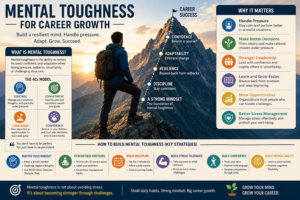
One widely used framework for understanding mental toughness is the Clough and Strycharczyk 4Cs Model, which describes four core dimensions:
1. Control
Control refers to your ability to manage your emotions, thoughts, and reactions when under pressure. A person with stronger control is less likely to become overwhelmed by a stressful situation and more likely to pause, assess what is happening, and respond intentionally.
2. Commitment
Commitment refers to your ability to stay focused on goals and follow through on responsibilities, even when motivation decreases or difficulties arise. It involves consistency, discipline, persistence, and the ability to keep moving forward without relying entirely on motivation.
3. Challenge
Challenge reflects how you interpret change, uncertainty, and obstacles. Rather than automatically viewing difficulties as threats, you are more likely to see them as situations that can provide opportunities to learn, adapt, and develop new skills.
4. Confidence
Confidence refers to your belief in your own abilities, decisions, and capacity to handle difficult situations. It does not mean believing you will always succeed. Instead, it involves trusting that you can learn from setbacks, make decisions, and cope with challenges even when the outcome is uncertain.
Together, these four dimensions provide a framework for understanding how people respond psychologically to pressure, setbacks, and change. In the workplace, developing these capacities can contribute to greater career resilience, more effective coping, and a stronger ability to navigate demanding situations.
Why Mental Toughness Is Essential for Career Growth
Mental toughness can play an important role in how you respond to workplace pressure, setbacks, uncertainty, and demanding situations. It does not guarantee career success, but it can strengthen the psychological skills needed to navigate challenges effectively.
1. Helps You Handle Pressure
Deadlines, performance evaluations, difficult clients, workplace conflicts, and high expectations can create significant stress. Mental toughness can help you regulate your emotional response, maintain perspective, and focus on what you can control rather than reacting impulsively.
2. Supports Better Decision-Making
Pressure can narrow your attention and make it harder to think clearly. Mental toughness encourages you to pause, assess the situation, consider your options, and make decisions based on available evidence rather than acting purely from fear, frustration, or panic.
3. Strengthens Leadership Skills
Leadership often involves uncertainty, difficult conversations, competing priorities, and responsibility for others. The ability to remain composed, regulate emotions, communicate clearly, and make thoughtful decisions under pressure can support effective leadership.
Mental toughness does not make someone a good leader by itself, but these psychological capacities can become valuable leadership skills.
4. Helps You Learn From Mistakes
Setbacks can trigger self-doubt, embarrassment, or fear of failure. Mental toughness can help you view mistakes as feedback rather than as proof of personal inadequacy.
Instead of thinking, “I failed, so I’m not capable,” you can ask: “What happened, what can I learn from it, and what can I do differently next time?”
This mindset makes it easier to recover, adapt, and continue developing your skills.
5. Supports Consistent Performance
Productivity is not simply about working harder. It also depends on your ability to maintain focus, manage distractions, regulate stress, and continue working toward priorities when motivation fluctuates.
Mental toughness can support this consistency by helping you stay engaged with important tasks without becoming completely derailed by every setback or stressful event.
6. Can Improve Your Ability to Navigate Career Opportunities
Career growth often requires stepping outside your comfort zone—applying for a challenging role, speaking up in meetings, taking responsibility, negotiating, learning new skills, or adapting to organizational changes.
Greater confidence, adaptability, and persistence can make it easier to recognize opportunities, tolerate uncertainty, and take constructive risks.
7. Supports Healthier Stress Management
Mental toughness does not eliminate stress, and it should never be used as an excuse to tolerate an unhealthy workload or toxic workplace.
Instead, it can help you respond to stress more effectively by improving emotional regulation, problem-solving, adaptability, and persistence.
True mental toughness also includes knowing when to rest, set boundaries, ask for help, or step back. Pushing through every difficulty without recovery is not resilience—it can contribute to exhaustion and burnout.
Ultimately, mental toughness is not about becoming someone who never struggles. It is about developing the psychological flexibility and coping skills to face challenges without allowing every setback to define your confidence, decisions, or direction.
Psychology Behind Mental Toughness
Mental toughness is not simply a matter of “having a strong mind.” Several psychological processes can influence how people respond to pressure, setbacks, uncertainty, and failure. Understanding these processes helps explain why resilience can be developed through repeated practice and healthier coping strategies.
1. Growth Mindset — Carol Dweck
A growth mindset is the belief that abilities and skills can develop through learning, effort, effective strategies, and experience.
Instead of interpreting a difficult task as proof that you are incapable, a growth-oriented person is more likely to think: “I’m not good at this yet, but I can improve.”
This perspective can make challenges feel more manageable and encourage persistence after setbacks.
However, a growth mindset does not mean believing that anything is possible through effort alone. Skills also depend on resources, opportunities, effective strategies, support, and individual circumstances.
2. Cognitive Behavioral Theory
Cognitive Behavioral Theory highlights the relationship between thoughts, emotions, and behaviours.
For example, receiving critical feedback may trigger the thought: “I’m terrible at my job.”
That interpretation may lead to anxiety, shame, avoidance, or procrastination.
A more balanced interpretation might be: “This feedback shows me something I need to improve.”
Changing unhelpful thinking patterns can influence emotional responses and behaviour, helping people cope with stressful situations more effectively.
Importantly, thoughts do not simply create emotions. Emotions are influenced by multiple factors, including our interpretations, experiences, physiological responses, environment, and circumstances.
3. Neuroplasticity
Neuroplasticity refers to the brain’s ability to change and adapt in response to learning, experience, and repeated patterns of behaviour.
When you repeatedly practice skills such as emotional regulation, problem-solving, attention control, or adaptive coping, those skills can become more familiar and efficient over time.
This is why mental toughness can be developed through practice rather than treated as a fixed personality trait.
The popular phrase “the brain can rewire itself” is useful as a simple explanation, but neuroplasticity is more complex than simply changing your brain through positive thinking.
4. Stress Inoculation Theory
Stress Inoculation Training (SIT), associated with psychologist Donald Meichenbaum, is based on the idea that people can develop stronger coping abilities by learning how to manage progressively challenging stressors.
The process generally involves:
Understanding stress → developing coping skills → practicing those skills → applying them to increasingly challenging situations.
For example, someone who fears speaking in meetings might begin by preparing and practicing their ideas privately, then speak briefly in a small meeting, and gradually take on more demanding speaking situations.
The goal is not to expose yourself to overwhelming stress. It is to develop effective coping skills while working with manageable levels of challenge.
5. Emotional Regulation
Mental toughness does not mean suppressing emotions.
Emotional regulation involves recognizing emotions, understanding what is triggering them, and choosing how to respond rather than automatically acting on the emotional impulse.
For example, feeling angry after receiving unfair criticism is normal. Emotional regulation means being able to acknowledge that anger while deciding whether, when, and how to respond constructively.
Over time, stronger emotional regulation can support better coping, clearer decision-making, interpersonal functioning, and recovery from stressful experiences.
The goal of mental toughness is therefore not to become emotionally unaffected.
It is to become better at experiencing difficult emotions without allowing them to completely control your behaviour.
12 Signs You May Need to Strengthen Your Mental Toughness
Everyone experiences stress, self-doubt, procrastination, and difficult emotions at times. These experiences do not automatically mean that you lack mental toughness.
However, if these patterns occur frequently, interfere with your work, or make it difficult to cope with everyday challenges, they may indicate areas where you could strengthen your resilience and coping skills.
1. You Become Easily Overwhelmed by Stress
Even relatively manageable work pressure can leave you feeling mentally overloaded or unable to think clearly.
2. You Struggle With Criticism
Feedback may feel like a personal attack rather than information that can help you improve.
3. You Avoid Difficult Tasks
You repeatedly postpone challenging conversations, responsibilities, or projects because they create discomfort or fear of failure.
4. You Overthink Decisions
You spend excessive time analyzing possibilities, worrying about making the wrong choice, or seeking reassurance before taking action.
5. You Take Setbacks Personally
A mistake or rejection quickly becomes a judgment about your ability or self-worth: “I failed” becomes “I am a failure.”
6. You Frequently Procrastinate
You know what needs to be done but repeatedly delay starting, particularly when a task feels difficult, uncertain, or uncomfortable.
7. You Struggle to Regulate Emotions Under Pressure
Stressful situations may trigger intense anxiety, frustration, anger, or emotional shutdown, making it difficult to respond thoughtfully.
8. You Struggle With Consistency and Discipline
You find it difficult to maintain important habits or responsibilities when motivation is low or circumstances become challenging.
9. You Give Up When Things Become Difficult
When progress is slow or obstacles appear, you may quickly lose motivation rather than adjusting your approach and continuing.
10. You Depend Heavily on External Motivation or Validation
You may find it difficult to trust your own judgment or stay committed unless someone else provides encouragement, approval, or reassurance.
11. Conflict Drains You Emotionally
Workplace disagreements, difficult conversations, or criticism can occupy your thoughts long after the situation has ended.
12. You Feel Overwhelmed by Responsibility
Taking on responsibility may trigger excessive worry, self-doubt, or the feeling that you will not be able to cope with the demands placed on you.
What Should You Do If You Recognize Yourself Here?
You do not need to “fix” every trait on this list.
Instead, identify one or two patterns that repeatedly create problems in your career or daily life and start working on those areas. Mental toughness is not about becoming emotionless, never struggling, or forcing yourself to tolerate everything.
It is about developing the ability to regulate your emotions, stay engaged with meaningful goals, adapt when circumstances change, learn from setbacks, and respond to challenges more effectively. And if stress, anxiety, emotional exhaustion, or difficulty functioning becomes persistent or severe, the goal should not simply be to become “tougher.” Professional support may be more appropriate than pushing yourself harder.

How to Build Mental Toughness for Career Growth: Step-by-Step
Mental toughness is not something you either have or do not have. It can be strengthened by repeatedly practicing skills such as adaptive thinking, emotional regulation, persistence, problem-solving, and coping with manageable challenges.
The goal is not to become unaffected by stress. It is to become better at responding to pressure without allowing difficult thoughts or emotions to automatically control your behaviour.
Master Your Mindset
1. Shift From a Fixed to a Growth Mindset
The way you interpret your abilities can influence how you respond to challenges and setbacks.
- A fixed mindset may sound like: “I’m either good at something or I’m not.”
- A growth-oriented mindset sounds more like: “I may not be good at this yet, but I can improve with practice, feedback, and the right strategies.”
How to develop a more growth-oriented mindset:
- Replace “I can’t do this” with “I can learn how to do this.”
- Focus on what you can improve rather than judging your natural ability.
- Treat mistakes as information about what needs to change.
- Ask, “What can I learn from this?” after a setback.
- Recognize effort, strategy, and progress—not just the final result.
The goal is not to convince yourself that every outcome will be successful. It is to develop the belief that your abilities can develop through learning and practice.
2. Challenge Unhelpful Thoughts
Under pressure, the mind can automatically produce catastrophic, self-critical, or threat-focused thoughts.
For example: “If I make one mistake in this presentation, everyone will think I’m incompetent.”
Instead of accepting the thought as fact, pause and examine it.
Ask yourself:
- Is this fear based on facts or assumptions?
- What evidence supports this thought?
- Evidence contradicts it?
- Am I catastrophizing the situation?
- What would I say to a colleague in the same situation?
- What is a more balanced way of looking at this?
For example:
- Instead of: “If I make a mistake, my career is over.”
- Try: “I may make mistakes under pressure, but one mistake does not define my professional ability. I can learn from feedback and improve.”
This process is consistent with Cognitive Behavioral Therapy (CBT), which focuses on identifying and evaluating unhelpful patterns of thinking and behaviour.
3. Use Mental Contrasting: The WOOP Method
Setting a goal is important, but simply imagining success is not always enough. Mental contrasting combines a desired future with an honest examination of the obstacles that could prevent you from reaching it.
The WOOP method provides a practical structure:
W — Wish
Identify what you want to achieve.
Example:
“I want to become more confident when speaking in meetings.”
O — Outcome
Identify the most meaningful result you expect if you achieve it.
Example:
“I will be able to communicate my ideas clearly and contribute more confidently.”
O — Obstacle
Identify the main internal or external obstacle that could get in your way.
Example:
“I become anxious and start overthinking before I speak.”
P — Plan
Create a specific if–then plan for dealing with that obstacle.
Example:
“If I start overthinking before speaking, I will take one slow breath, focus on my main point, and speak within the next few moments rather than waiting for the perfect wording.”
This turns a vague goal into a specific coping strategy.
Mental toughness develops when you repeatedly identify challenges, anticipate obstacles, and practice responding to them effectively.
Strengthen Emotional Regulation
Mental toughness does not mean controlling or suppressing every emotion. It means developing the ability to notice emotions, tolerate discomfort, regulate your response, and choose how you act rather than reacting automatically.
1. Practice the 10-Second Pause
When emotions become intense, creating a short pause can give you enough space to respond rather than react impulsively.
Try the following: Pause → Breathe → Notice → Respond
For example, if a colleague sends you an upsetting message, resist the urge to reply immediately. Take a few slow breaths, notice what you are feeling, and then decide how you want to respond.
A short pause does not eliminate strong emotions, but it can create valuable space between the emotional trigger and your behavioural response.
2. Learn to Label Your Emotions
Affect labeling refers to putting feelings into words.
Instead of vaguely thinking, “I feel terrible,” try identifying the specific emotion:
- “I’m feeling stressed.”
- “Feeling disappointed.”
- “I’m feeling frustrated.”
- “Feeling anxious.”
- “I’m overwhelmed.”
Naming an emotion can help you understand what is happening internally and create psychological distance from the experience.
The goal is not to make the emotion disappear. It is to move from “I am overwhelmed” toward “I am experiencing overwhelm right now.”
3. Develop Stress-Management Habits
Mental toughness is easier to build when your baseline stress is managed rather than constantly pushed beyond its limits.
Useful practices include:
- Mindful breathing
- Yoga or gentle movement
- Journaling
- Nature walks
- Meditation
- Regular physical activity
- Adequate sleep and recovery
The most important factor is consistency, not doing everything at once. Choose practices that are realistic enough to maintain over time.
Build Discipline and Consistency
Mental toughness is not only about how you respond during a crisis. It is also built through the small behaviours you repeatedly practice when nobody is watching.
1. Use the 2-Minute Rule Strategically
If a task takes roughly two minutes or less, completing it immediately can prevent small tasks from accumulating.
For example:
- Replying to a simple message
- Filing a document
- Putting something back in its place
- Confirming an appointment
However, the 2-minute rule should not become an excuse to constantly interrupt important work. For larger or cognitively demanding tasks, prioritization and focused work are more useful than immediate action.
2. Create a Daily Non-Negotiable Routine
Choose a few small behaviours that support your long-term goals.
For example:
- Reading 10 pages
- Writing your top three priorities
- Exercising for 20 minutes
- Practicing a professional skill
- Spending 10 minutes reviewing what you learned
The goal is not to create an impossibly strict routine.
Consistency matters more than intensity.
Repeatedly keeping small commitments to yourself can strengthen self-discipline and confidence in your ability to follow through.
3. Use the “Top 3” Priority Rule
Long to-do lists can create the illusion of productivity while leaving you overwhelmed.
Instead, identify the three most important tasks for the day.
Ask:
- What absolutely needs to be done?
- Will have the greatest impact?
- What can realistically be completed today?
Then focus on those priorities before filling your schedule with less important tasks.
Quality and meaningful progress matter more than simply checking more boxes.
Build Stress Tolerance Through Gradual Challenges
Avoiding every uncomfortable situation can reinforce fear and reduce confidence. On the other hand, overwhelming yourself with extreme challenges is not resilience training.
A better approach is gradual exposure to manageable challenges.
1. Start With Small Stressors
Choose situations that are uncomfortable but realistically manageable.
For example:
- Responding to a difficult email calmly
- Speaking up during a meeting
- Learning unfamiliar software
- Taking responsibility for a small project
- Having a difficult but necessary conversation
After each experience, reflect: What did I expect to happen? What actually happened? What did I learn?
Repeated experiences of successfully handling manageable challenges can strengthen confidence in your ability to cope.
2. Practice Discomfort Intentionally
You can also deliberately practice staying focused when something feels uncomfortable.
Try:
- Completing a 20-minute focused work session
- Starting an important task before doing easier tasks
- Delaying unnecessary distractions
- Working through a manageable period of frustration without immediately escaping it
- Practicing a difficult skill consistently
The purpose is not to suffer unnecessarily.
It is to learn: “I can experience discomfort without immediately avoiding it.”
This distinction is important. Mental toughness is not about tolerating harmful or overwhelming situations. It is about developing the capacity to handle manageable discomfort constructively.
Build Confidence
Confidence is not simply positive thinking. It is strengthened through experience, competence, preparation, and evidence that you can handle challenges.
1. Track Your Wins
Create a simple success journal and regularly record:
- What you achieved
- You learned what
- What difficult situation you handled
- Mistake you recovered from
- What skill you improved
This helps you build a realistic record of your progress rather than allowing one setback to erase everything you have accomplished.
2. Develop Confident Communication
Body language can influence how you present yourself, but confidence should not be reduced to posture alone.
Practice:
- Maintaining appropriate eye contact
- Speaking clearly
- Using an appropriate pace
- Sitting or standing comfortably
- Avoiding excessive apologizing
- Expressing your opinions respectfully
- Asking questions when you need clarification
The objective is not to “look powerful.” It is to communicate with clarity, composure, and self-respect.
3. Develop Competence
Confidence becomes more stable when it is supported by actual skills and experience.
Invest in areas such as:
- Communication
- Decision-making
- Leadership
- Project management
- Problem-solving
- Technology and digital skills
- Professional knowledge
The more capable you become, the more evidence you have that you can handle challenges.
Build Mental Agility
Mental toughness also requires adaptability. Being mentally strong does not mean stubbornly following the same plan when circumstances have changed.
1. Learn to Pivot When Necessary
Work environments rarely remain predictable.
You may need to adapt when:
- Deadlines change
- Priorities shift
- A colleague behaves unexpectedly
- A project changes direction
- New responsibilities are assigned
- A strategy stops working
Instead of asking only: “Why is this happening?”
also ask: “Given the situation now, what is the most effective next step?”
Adaptability allows you to respond to reality rather than remaining attached to an outdated plan.
2. Practice Cognitive Flexibility
Cognitive flexibility is the ability to consider different perspectives, adjust your thinking, and change strategies when circumstances require it.
You can practice it by:
- Learning a new skill
- Approaching a problem in more than one way
- Considering another person’s perspective
- Changing an established routine occasionally
- Asking yourself what information could change your current opinion
- Trying a different strategy when the first one fails
For example, if a particular study or work method repeatedly produces poor results, mental flexibility means being willing to ask: “Is there another way I can approach this?”
The goal is not to change your mind constantly. It is to become capable of changing your approach when evidence shows that your current approach is no longer effective.
True mental toughness therefore combines emotional regulation, discipline, stress tolerance, confidence, and adaptability. It is not simply the ability to endure more pressure—it is the ability to respond to pressure more effectively.
Build Professional Independence
1. Rely Less on External Validation: Stop needing constant approval. Trust your skills and judgment.
2. Learn Decision-Making: Use the 70% Rule: If you have 70% information, decide. Waiting for perfection causes paralysis.
3. Set Boundaries
Examples:
- No work after 8 PM
- No saying yes to everything
- No burnout-inducing workload
Strong boundaries = strong mind.
Mental Toughness and Leadership
Leaders need the ability to:
- Stay calm in crisis
- Make difficult decisions
- Solve conflicts
- Motivate teams
- Handle criticism
- Manage unpredictable environments
Mental toughness is a primary trait of high-performing leaders like CEOs, managers, entrepreneurs, and innovators.
Career Situations Where Mental Toughness Helps Most
- Job Interviews: You become more confident and articulate.
- Workplace Conflicts: You learn to respond calmly, not react emotionally.
- High-Pressure Projects: Resilience prevents burnout.
- Leadership Roles: You handle responsibility without breaking down.
- Skill Development: You stay consistent despite challenges.
- Career Transitions: You adapt easily to new environments.
- Entrepreneurship: You handle uncertainty without anxiety.
How to Stay Tough When Work Gets Hard
1. Avoid Catastrophizing
Replace: “This project will fail.” with “I need a better strategy.”
2. Reframe Problems
Ask: “What is this trying to teach me?”
3. Don’t Personalize Criticism
Focus on feedback, not ego.
4. Practice Patience
Long-term careers require long-term resilience.
5. Avoid Reacting Emotionally
Learn to think before responding.
Mental Toughness Mistakes to Avoid
- Suppressing emotions instead of regulating them
- Becoming cold or insensitive
- Overworking to “prove toughness”
- Being stubborn instead of adaptable
- Avoiding help
- Ignoring burnout
- Seeking perfection
True mental toughness is balanced, not extreme.
Daily Routine to Build Mental Toughness
Here is a practical routine:
Morning
- 10-minute meditation
- Affirmations
- 20-minute workout
- Review goals
- Check important tasks
Workday
- 3-task focus
- 10-minute deep breathing
- Take micro-breaks
- Practice confident communication
Evening
- Reflection journal
- Gratitude list
- Light reading
- Relaxation activity
This builds emotional stability and career resilience over time.
Scientific Habits That Strengthen Mental Toughness
- Sleep hygiene
- Positive visualization
- Cold exposure
- Dopamine detox
- Mindful self-talk
- Delayed gratification
- Consistency rituals
These are proven by neuroscience to enhance emotional control.
Conclusion
Mental toughness is not inborn—it is trained.
Every skill you practice, every challenge you embrace, every fear you face makes you stronger.
With mental toughness, you can:
- Grow your career
- Lead confidently
- Handle stress wisely
- Make better decisions
- Bounce back stronger
In a competitive world, those who stay emotionally stable, adaptable, and disciplined rise the fastest.
Your career success is not just about talent—it’s about the strength of your mind.
Reference
-
American Psychological Association (APA) – Stress & resilience research
https://www.apa.org -
Harvard Business Review – Career performance, leadership, and resilience
https://hbr.org -
Harvard Health – Emotional regulation & stress science
https://www.health.harvard.edu -
Mind Tools – Workplace resilience & productivity
https://www.mindtools.com - Soft Launch vs Hard Launch Relationships: The Psychology Behind It
- Contact us
Pingback: Workplace Burnout: Early Signs You Must Know