
“Modern Dating Burnout: You’re Not Tired of Love—You’re Tired of What Dating Has Become.”
Introduction: Love in the Age of Exhaustion (Modern Dating Burnout)
Modern dating should have been easier—after all, technology has given us thousands of options, endless ways to communicate, and more freedom to choose our partners. But for Gen Z, dating has become emotionally draining, confusing, and often disappointing.
From swipe fatigue to ghosting, unrealistic expectations, and fear of emotional vulnerability, young people today are entering adulthood with Modern Dating Burnout—a deeper exhaustion where romance feels less exciting and more like a chore.
This article explores the psychology behind Modern Dating Burnout, why Gen Z feels this way, and what we can do to build healthier romantic connections.
What Is Modern Dating Burnout? (Psychological Meaning)
Modern Dating Burnout refers to a state of emotional, cognitive, and psychological exhaustion associated with repeated or stressful romantic experiences. Although “Modern Dating Burnout” is not a formal psychiatric diagnosis, the experience can resemble other forms of burnout: a person becomes emotionally depleted, loses motivation, develops negative expectations, and begins to withdraw from the activity that once felt exciting.
For some people, dating starts with curiosity and optimism. They enjoy meeting new people, having conversations, going on dates, and imagining the possibility of finding a meaningful relationship. But after repeated disappointments—such as ghosting, rejection, inconsistent communication, situationships, or constantly starting over—the emotional experience can change.
Instead of thinking, “Maybe this person could be someone special,” the person may begin thinking, “This is probably going to end badly anyway.”
That shift is important. Modern Dating Burnout is not necessarily a loss of the desire for love. Often, it is a loss of emotional energy available for pursuing love.
A person experiencing Modern Dating Burnout may notice:
- Feeling tired of using dating apps or constantly meeting new people
- Feeling emotionally drained after conversations or dates
- Losing enthusiasm about romantic possibilities
- Feeling numb, detached, or indifferent rather than excited
- Becoming pessimistic about relationships
- Expecting new connections to end in disappointment
- Avoiding dating because it feels like too much effort
- Feeling that dating has become another responsibility rather than an enjoyable experience
- Repeatedly thinking, “I don’t have the energy for this anymore”
- Wanting intimacy while simultaneously avoiding the process required to build it
This creates a psychological paradox: the person may still want a relationship, but no longer want to participate in the process of finding one.
Modern Dating Burnout Is More Than “Being Tired of Dating”
Everyone can become temporarily tired of dating. Taking a break after a difficult date or losing interest in an app for a few weeks does not automatically indicate burnout.
Modern Dating Burnout becomes more significant when exhaustion begins influencing a person’s expectations, emotional responses, and behavior.
For example, someone might stop responding to potential partners not because they are uninterested in connection, but because they have already mentally associated dating with rejection, disappointment, or emotional effort.
The problem then becomes self-reinforcing:
Repeated disappointment → emotional exhaustion → reduced motivation → avoidance → fewer opportunities for healthy connection → stronger belief that meaningful relationships are difficult or impossible.
This does not mean every person who avoids dating is experiencing burnout. Some people simply prefer being single, are not currently interested in relationships, or are intentionally taking a break. The key difference is whether the withdrawal feels like a healthy choice or an exhausted attempt to protect oneself from further emotional strain.
The Psychological Processes Behind Modern Dating Burnout
Modern Dating Burnout can overlap with several established psychological processes.
1. Cognitive Overload
Modern dating can require constant mental processing. A person may simultaneously evaluate multiple profiles, conversations, intentions, compatibility factors, and social signals.
Questions such as “Why did they reply differently today?”, “Should I text first?”, “Are they actually interested?”, or “Should I give this person another chance?” can create a continuous stream of decision-making.
When the mind is repeatedly required to evaluate possibilities, ambiguity, and choices, dating can begin to feel mentally exhausting rather than emotionally rewarding.
2. Decision Fatigue
Dating platforms can present people with an extraordinary number of potential choices. Instead of meeting one person and gradually discovering compatibility, users may encounter a seemingly endless stream of alternatives.
This can encourage constant comparison:
Is there someone better? Should I keep looking? Am I settling?
The result can be difficulty committing to a decision, dissatisfaction with available options, or exhaustion from repeatedly making romantic choices.
3. Emotional Depletion
Every new romantic interaction requires some degree of emotional investment. Even when a relationship does not become serious, a person may spend time communicating, anticipating, hoping, explaining themselves, and imagining possibilities.
When these efforts repeatedly end without meaningful connection, emotional resources can become depleted.
Eventually, another conversation may not feel exciting. It may feel like work.
4. Rejection Sensitivity
Repeated rejection can influence how a person interprets future interactions. Someone who has experienced several painful rejections may become increasingly alert to signs that another person is losing interest.
A delayed message might therefore be interpreted not simply as a delayed message, but as evidence of another impending rejection.
This can increase anxiety, overthinking, and emotional defensiveness.
5. Attachment Insecurity
Dating experiences can also interact with attachment-related patterns.
A person with more anxious attachment tendencies may become highly focused on reassurance, communication frequency, and signs of abandonment. Someone with more avoidant tendencies may respond to emotional pressure by creating distance or suppressing their need for closeness.
These patterns do not mean that a person’s attachment style permanently determines their relationships. Attachment patterns can change, and people can behave differently across different relationships and circumstances.
However, when insecurity combines with repeated ambiguous dating experiences, emotional exhaustion can become more likely.
Why Gen Z May Experience Modern Dating Burnout Differently
Gen Z has come of age in a highly digital dating environment. For many young adults, romantic interaction can begin, develop, and end through smartphones.
A person can meet someone through an app, communicate through messaging, monitor their social-media activity, interpret their online behavior, and experience rejection—all without having many face-to-face interactions.
This creates a dating environment with high connectivity but not necessarily high emotional security.
There is also a constant exposure to relationship content online. Social media can present idealized couples, dramatic breakups, dating advice, relationship “rules,” and highly curated versions of intimacy. When people repeatedly compare their private relationships with other people’s public presentations, ordinary relationships can appear inadequate.
At the same time, modern dating offers greater freedom to define relationships differently. People may choose traditional relationships, casual dating, non-exclusive dating, or intentionally remain single. That flexibility can be positive, but it can also create uncertainty when two people have different expectations and fail to communicate them clearly.
Therefore, the issue is not simply that “Gen Z does not know how to date.”
A more useful psychological interpretation is that young adults are navigating romantic relationships within an environment characterized by high choice, rapid communication, constant comparison, ambiguous expectations, and repeated opportunities for connection and rejection.
When these factors accumulate, dating can become emotionally exhausting.
Ultimately, Modern Dating Burnout does not necessarily mean that someone has stopped believing in love. In many cases, it means they have become exhausted by the process of searching for, maintaining, and making sense of romantic connection.
The person may still deeply desire intimacy. What they have lost is the energy to keep exposing themselves to uncertainty in the hope of finding it.
Why Gen Z Is Experiencing Modern Dating Burnout: 12 Psychological Reasons
Modern Dating Burnout rarely comes from one disappointing date or one bad relationship. More often, it develops through the cumulative effect of repeated emotional demands.
Modern dating asks people to make decisions, manage uncertainty, communicate constantly, tolerate rejection, interpret ambiguous signals, and repeatedly make themselves emotionally vulnerable. At the same time, social media creates an environment where relationships are constantly compared, evaluated, and publicly displayed.
For Gen Z, who have grown up alongside smartphones, social media, and dating platforms, romantic relationships can therefore involve a unique combination of high accessibility and high emotional pressure.
Here are 12 psychological factors that can contribute to Modern Dating Burnout.
1. Too Many Options → Decision Fatigue
One of the defining characteristics of app-based dating is the sheer number of potential choices.
Instead of meeting a small number of people through friends, education, work, or local social networks, dating apps can present users with a seemingly endless stream of profiles. This creates what can feel like an illusion of abundance: if one person does not work out, another option appears only a swipe away.
At first, this can feel liberating. But psychologically, having more choices does not always produce greater satisfaction.
Every potential match requires some degree of evaluation: Are they attractive? Are they compatible with me? Should I reply? Should I meet them? Do I like them enough? Could there be someone better?
This repeated evaluation can contribute to decision fatigue and cognitive overload.
A person may begin to experience:
- Feeling overwhelmed by the number of potential matches
- Difficulty deciding whom to invest time in
- Constantly comparing potential partners
- Fear of making the “wrong” choice
- Worry about settling when better options might exist
- Difficulty committing to one person
The problem is not simply having choices. It is the psychological habit of continually evaluating alternatives.
When the mind remains focused on finding the optimal partner, it becomes difficult to focus on developing an actual connection with the person in front of you.
This can create a paradox: More options → more comparison → more uncertainty → less satisfaction → less emotional investment.
Eventually, dating can begin to feel less like discovering a relationship and more like making an endless series of consumer decisions.
2. “Swipe Culture” Can Encourage Rapid Judgments
Dating apps have transformed the initial stages of romantic attraction into an extremely fast visual process.
A photograph, short biography, location, occupation, or a few prompts may become the basis for deciding whether someone is worth further attention.
This encourages rapid evaluation.
Within seconds, a person may decide: Attractive or unattractive? Interesting or boring? Compatible or incompatible? Swipe right or left?
There is nothing inherently wrong with having preferences. The psychological concern arises when repeated rapid judgments become the dominant way people approach romantic connection.
Swipe-based environments can encourage:
- Quick judgments
- Greater emphasis on appearance
- Surface-level screening
- Rapid rejection
- Constant comparison
- Reduced tolerance for ambiguity
Human attraction, however, is more complex than a profile.
Personality, humor, emotional intelligence, values, communication style, warmth, and compatibility often become clearer only through interaction and time. When people become accustomed to evaluating potential partners within seconds, they may also become less willing to tolerate the normal uncertainty of getting to know someone.
This can contribute to Modern Dating Burnout because every interaction starts to feel like another evaluation.
- The person is no longer simply asking: “Who might I connect with?”
- They may begin asking: “Is this person worth my time compared with all the other options?”
That subtle psychological shift can make dating feel transactional.
3. Rejection Fatigue, Ghosting, and Inconsistent Attention
Rejection is an unavoidable part of dating, but repeated rejection can become emotionally exhausting.
Online dating can make rejection particularly frequent and ambiguous. A conversation may suddenly stop. Someone may disappear after several promising dates. A match may never respond. Someone may maintain contact without actually progressing the relationship.
These experiences are often described using terms such as ghosting, breadcrumbing, and benching.
The psychological impact is not always about rejection itself.
Ambiguity can be especially difficult because the brain wants an explanation.
When someone disappears without explanation, the person left behind may repeatedly ask:
Did I do something wrong? Were they never interested? Did I say something? Was someone else better?
This uncertainty can encourage rumination. Repeated experiences may eventually produce rejection fatigue—a state in which the person becomes increasingly reluctant to invest emotionally because they expect another disappointment.
They may begin to feel:
- “I am probably going to get rejected anyway.”
- “People always lose interest eventually.”
- “There is no point getting attached.”
- “I don’t want to go through this again.”
Over time, protective pessimism can develop.
Importantly, rejection does not automatically damage self-esteem. People differ considerably in how they interpret rejection. Someone with strong self-worth may see it as incompatibility, while someone who already doubts themselves may interpret it as evidence that they are fundamentally undesirable.
This is where rejection sensitivity becomes relevant. The more strongly someone anticipates rejection, the more likely they may be to monitor interactions for signs of abandonment or disinterest.
Dating then becomes emotionally expensive before anything has even happened.
4. Attachment Insecurity Can Intensify Dating Stress
Attachment theory provides another useful lens for understanding why different people respond differently to the same dating experience.
People with more anxious attachment tendencies may become highly sensitive to changes in communication, uncertainty, or perceived rejection. They may repeatedly check messages, worry about whether someone is losing interest, or seek reassurance. Someone with more avoidant attachment tendencies, on the other hand, may feel uncomfortable with increasing emotional closeness and respond to vulnerability by creating distance.
There can also be a push-pull pattern in which a person strongly desires intimacy but becomes uncomfortable once intimacy develops. Modern dating environments can intensify these patterns because communication is often ambiguous and highly visible.
- A delayed response can be interpreted as rejection.
- Change in texting frequency can be interpreted as loss of interest.
- A person becoming active on a dating app can trigger insecurity.
However, it is important not to conclude that Gen Z is inherently more insecurely attached than previous generations. Attachment is influenced by many factors, including early relationships, later experiences, personality, and relationship context.
The more accurate point is that digital dating can provide fertile ground for attachment-related anxiety or avoidance to become activated. When uncertainty repeatedly triggers these patterns, dating can become emotionally exhausting.
5. Social Media Creates Unrealistic Relationship Standards
Social media does not simply show relationships.
It often shows edited versions of relationships.
Couples post anniversary surprises, expensive dates, elaborate proposals, romantic vacations, matching outfits, affectionate messages, and carefully selected photographs. What remains invisible are ordinary arguments, boredom, financial stress, communication problems, incompatible expectations, and the countless mundane moments that make up real relationships.
This creates a psychological problem known as social comparison. People naturally compare themselves with others, particularly when the comparison target appears more successful or desirable.
A young person might therefore look at social media and think: “Everyone else is in love except me.” Or: “Why doesn’t my relationship look like that?” Or: “If my partner really loved me, wouldn’t they do things like this?”
Repeated exposure to idealized relationship content can distort expectations about intimacy.
Gen Z may encounter:
- “Relationship goals” content
- Perfect-couple narratives
- Grand romantic gestures
- Luxury dates
- Highly curated anniversaries
- Viral relationship advice
- Public declarations of love
The danger is not social media itself.
The problem occurs when curated content becomes the benchmark for evaluating private relationships. Real intimacy is usually less dramatic than online content. Healthy relationships can be repetitive, imperfect, ordinary, and still deeply fulfilling. When people expect constant excitement and visible proof of love, normal relationship experiences may feel disappointing.
6. Fear of Vulnerability
Healthy intimacy requires vulnerability.
To become emotionally close to another person, people eventually have to reveal their fears, needs, insecurities, expectations, boundaries, and emotional history.
But vulnerability also creates risk. If someone opens up and gets rejected, mocked, betrayed, manipulated, or abandoned, the experience can teach them that emotional openness is dangerous.
This can lead to protective behaviors such as:
- Avoiding serious conversations
- Keeping relationships casual
- Hiding emotional needs
- Refusing to define the relationship
- Maintaining emotional distance
- Leaving when intimacy begins increasing
This is one reason situationships can become appealing.
A situationship may provide companionship, attraction, and emotional closeness while postponing the vulnerability associated with clearly defining the relationship. The difficulty is that emotional ambiguity does not necessarily eliminate vulnerability.
Instead, it can create a different form of psychological stress. One person may secretly want commitment while pretending to be comfortable with casual dating. Another may avoid asking for clarity because they fear losing the connection.
The result is often uncertainty without security. For someone already emotionally exhausted, repeatedly navigating these unclear connections can make future dating feel even more threatening.
7. Previous Toxic Relationships Can Create Dating Fatigue
Past relationships can influence how people approach future relationships.
Someone who has experienced betrayal, cheating, manipulation, emotional abuse, or repeated invalidation may enter a new relationship with understandable caution.
They may think: “What if it happens again?”
This does not necessarily mean they are incapable of trusting someone new. It means previous experiences can influence their expectations and threat perception.
After a painful relationship, a person may become hypervigilant for warning signs.
They may closely monitor:
- Changes in communication
- Contradictory behavior
- Secrecy
- Emotional withdrawal
- Controlling behavior
- Inconsistency
- Signs of manipulation
Some caution is healthy. Recognizing red flags can protect people from unhealthy relationships.
The problem develops when past danger becomes the template for interpreting every future relationship. A person may begin assuming: “Everyone eventually hurts you.” As a result, they may protect themselves by avoiding emotional investment altogether.
Previous relational trauma can therefore contribute to Modern Dating Burnout—not because the person does not want love, but because love has become associated with emotional risk.
8. Career Pressure, Financial Stress, and Emotional Depletion
Dating does not happen in a psychological vacuum.
People enter romantic relationships while simultaneously managing education, employment, financial uncertainty, family expectations, career competition, housing costs, and concerns about the future.
For many young adults, these pressures can consume a substantial amount of emotional bandwidth.
When someone is already overwhelmed by life, dating can feel like another task requiring:
- Time
- Attention
- Planning
- Money
- Emotional availability
- Communication
- Decision-making
The person may genuinely want companionship but lack the psychological resources required to pursue it. This is an important distinction.
- Sometimes the problem is not: “I don’t want a relationship.”
- It is: “I don’t currently have the capacity for one.”
Chronic stress can reduce patience, emotional regulation, motivation, and willingness to tolerate uncertainty. As a result, difficulties in other areas of life can spill over into romantic relationships.
When someone feels exhausted everywhere else, even a potentially positive dating experience may feel like additional work.
9. The Mismatch Between Casual Dating and Emotional Needs
Casual dating and sexual relationships are not inherently unhealthy. People have different relationship preferences, and consensual casual relationships can be perfectly compatible with individual values and needs.
The psychological difficulty arises when the relationship arrangement does not match what a person actually wants. Someone may agree to casual dating because they are afraid that asking for commitment will cause the other person to leave. Another person may genuinely want something casual but behave in ways that create emotional expectations.
This mismatch can produce:
- Confusion
- Emotional insecurity
- Unclear expectations
- Difficulty trusting the other person
- Feelings of emptiness
- Lower relationship satisfaction
The issue, therefore, is not simply “hookup culture.”
It is the gap between stated expectations and underlying emotional needs.
A person who wants emotional intimacy but repeatedly enters connections that provide little emotional security may eventually become exhausted and conclude that dating itself is the problem.
10. Pandemic-Era Disruption of Social Development
The COVID-19 pandemic disrupted social interaction during important developmental periods.
Adolescents and young adults experienced periods of isolation, remote education, reduced peer interaction, and restrictions on face-to-face social activities. For some people, this affected opportunities to practice everyday interpersonal skills.
Dating normally involves learning how to:
- Start conversations
- Read social cues
- Handle awkwardness
- Express attraction
- Communicate boundaries
- Resolve misunderstandings
- Tolerate rejection
- Build relationships gradually
When significant periods of social development occur primarily through screens, returning to face-to-face interaction can feel uncomfortable.
Some young adults may therefore experience:
- Increased social anxiety
- Difficulty initiating conversations
- Fear of awkwardness
- Reduced confidence in face-to-face flirting
- Difficulty communicating emotions directly
This does not mean that the pandemic permanently damaged an entire generation’s social skills. Rather, it created a major disruption that affected people differently.
For someone already anxious about dating, reduced social practice can make romantic interactions feel particularly demanding.
11. Emotional Overload From Constant Online Communication
- Modern romantic communication rarely ends when the date ends.
- Messages continue throughout the day.
- Notifications arrive while working.
- A person may see that their partner is online but has not replied.
- They may notice that someone viewed their story.
- May analyze the meaning of a short response.
- They may reread a conversation looking for hidden signals.
This creates a new form of continuous relational monitoring. Technology can make communication easier, but it can also make emotional availability feel like an expectation.
People may feel pressure to:
- Respond immediately
- Maintain conversations throughout the day
- Explain changes in texting behavior
- Interpret emojis and punctuation
- Monitor online activity
- Manage misunderstandings through text
- Remain constantly available
The problem is that digital communication removes many of the cues available during face-to-face interaction. Tone, facial expression, pauses, body language, and context are often missing. As a result, a simple message can become a source of overinterpretation.
- “Okay.”
- “Why did they just say okay?”
- “Are they angry?”
- “Are they losing interest?”
A five-second message can trigger a thirty-minute internal conversation. Repeated often enough, this can contribute to cognitive and emotional exhaustion.
12. The Shift From Clear Dating Scripts to Relationship Ambiguity
Older dating cultures often followed more recognizable social scripts: people dated, became exclusive, introduced each other to family or friends, and gradually moved toward established relationship milestones.
Modern relationships can be much more flexible. That flexibility has genuine advantages. People have greater freedom to define relationships according to their individual preferences rather than following a single traditional model.
But flexibility can also create ambiguity. Two people may be emotionally involved but disagree about what the relationship actually is. One person may assume exclusivity. The other may assume they are still casually dating. One person may see frequent communication as evidence of commitment.
The other may see it simply as companionship. This uncertainty can create psychological strain because humans generally function better when important interpersonal expectations are reasonably clear. Ambiguous relationships can encourage questions such as: “Where is this going?”, “Are we exclusive?”, “Do they actually like me?”, “Should I ask?”, “What happens if I ask and they leave?”
The longer uncertainty continues, the more emotional energy may be spent trying to interpret the relationship instead of actually experiencing it. This is why clarity is not the enemy of romance. Clear communication can reduce unnecessary uncertainty and allow two people to make informed decisions about whether their needs and expectations are compatible.
The Bigger Picture: Modern Dating Burnout Is Usually Cumulative
None of these factors operates in isolation.
A person may be dealing with dating-app overload while simultaneously experiencing financial stress, previous relationship trauma, social-media comparison, rejection sensitivity, and uncertainty about commitment.
Consider someone who has already experienced a painful breakup.
They return to a dating app and encounter hundreds of profiles. Begin comparing potential partners, match with someone, become emotionally invested, and then get ghosted. They see couples posting romantic content online and start questioning their own love life.
The experience may reinforce an existing belief: “Dating is exhausting, and relationships always end badly.”
- That belief then influences future behavior.
- Swipe less.
- Respond less.
- They avoid vulnerability.
- Become suspicious of new partners.
- They interpret small disappointments as confirmation.
And eventually, they may conclude: “I don’t want love anymore.”
But psychologically, the deeper reality may be: “I still want love. I just don’t want to keep experiencing relationships this way.”
That distinction is crucial. Modern Dating Burnout is often not caused by a lack of desire for connection. It can emerge when the emotional cost of searching for connection repeatedly exceeds the perceived reward.
Understanding that difference is the first step toward changing the pattern.
3. Signs of Modern Dating Burnout in Gen Z
Modern Dating Burnout does not always look like someone openly saying, “I am tired of dating.” Often, it appears through subtle changes in emotions, thoughts, behavior, and even physical well-being.
A person may still want love while simultaneously feeling exhausted by the process of finding it. They may continue using dating apps, talking to people, or going on dates, but internally feel increasingly detached, frustrated, or hopeless. The signs can generally be understood across four areas: emotional, cognitive, behavioral, and physical.
It is also important to remember that these signs are not a diagnostic checklist. Experiencing one or two of them does not automatically mean someone has Modern Dating Burnout. The more meaningful indicator is a persistent pattern of exhaustion, negativity, and withdrawal specifically connected to dating and romantic experiences.
1. Emotional Signs
Feeling Numb During Conversations
One of the earliest signs may be emotional numbness.
Conversations that once created curiosity or excitement may begin to feel repetitive and meaningless. A person may respond to messages, but without genuinely looking forward to hearing from the other person.
They may think: “I know how this is going to end.”
This emotional detachment can function as a psychological protective response. After repeated disappointment, reducing emotional investment can feel safer than becoming hopeful again. The person is not necessarily incapable of feeling attraction. They may simply have become emotionally overextended.
Low Excitement About Dates
Modern Dating Burnout can make even potentially enjoyable dates feel like obligations.
Instead of getting excited about meeting someone new, the person may think:
- “I don’t feel like getting ready.”
- “This is probably going to be a waste of time.”
- “I have to start the whole process again.”
- “What if we don’t click?”
This is different from ordinary nervousness before a date. Defining feature is often a loss of positive anticipation. The activity that was once associated with possibility now becomes associated with effort.
Loss of Interest in Romance
Some people begin questioning whether they even want a relationship anymore. They may stop fantasizing about romantic possibilities or become indifferent when someone expresses interest.
However, this does not necessarily mean that their underlying need for connection has disappeared. Sometimes the person wants intimacy but has become exhausted by the process and uncertainty involved in obtaining it.
This distinction matters because temporarily losing interest in dating can be a healthy response to emotional overload. A break can provide recovery. The concern arises when emotional exhaustion becomes generalized hopelessness about relationships.
Irritability and Mood Changes
Repeated emotional uncertainty can lower a person’s tolerance for frustration.
Small dating-related events may trigger disproportionate irritation:
- A late reply
- Someone canceling plans
- Mixed signals
- A vague response
- Another disappointing conversation
The irritation may not actually be about that single event. It can represent the accumulation of many previous experiences.
In other words, the emotional reaction may be saying: “I cannot deal with another disappointment.”
Modern Dating Burnout can therefore make people more emotionally reactive, particularly when they are already under stress in other areas of life.
Feeling Empty After Dating Attempts
Another common experience is a sense of emptiness after dates or romantic interactions.
The person may spend time talking to someone, feel temporarily hopeful, and then return home feeling strangely drained.
- Instead of: “That was exciting.”
- The reaction becomes: “What was the point?”
This emotional crash can occur when the psychological investment in finding connection repeatedly fails to produce the desired outcome.
Over time, the person may begin protecting themselves by expecting less.
2. Cognitive Signs
Modern Dating Burnout also changes the way a person thinks about relationships.
Overanalysing Messages
Digital communication provides endless opportunities for interpretation.
A person may repeatedly analyze:
- How quickly someone replied
- Why their messages became shorter
- Whether an emoji means something
- Why they were active but did not respond
- Whether a change in texting frequency means they are losing interest
This can become a cycle of rumination.
The person attempts to reduce uncertainty by thinking more, but excessive analysis often creates even more uncertainty. Instead of asking the other person directly, they may try to decode every digital signal.
Expecting Failure From New Connections
Previous disappointments can influence future expectations.
Someone who has repeatedly experienced ghosting, rejection, betrayal, or inconsistent relationships may begin approaching every new connection defensively.
They may think:
- “Eventually they will leave.”
- “People always lose interest.”
- “This will probably end badly.”
This is an example of how previous experiences can shape expectations about future relationships.
The person may therefore experience disappointment before the relationship has actually given them a reason to be disappointed.
Catastrophizing
Modern Dating Burnout can also involve cognitive distortions such as catastrophizing.
A single negative experience may become evidence for a much broader conclusion:
- “This person rejected me, so nobody will want me.”
- “Relationship failed, so all relationships fail.”
- “They stopped replying, so I will always end up alone.”
The mind moves from a specific event to an extreme prediction about the future. This can reinforce hopelessness and make the person less willing to take healthy emotional risks.
Negative Self-Talk
Repeated rejection can sometimes become internalized.
Instead of viewing incompatibility as a normal part of dating, the person may interpret it as evidence of personal inadequacy.
Thoughts may include:
- “Something is wrong with me.”
- “I am not attractive enough.”
- “I am too difficult to love.”
- “Nobody will choose me.”
- “I always ruin relationships.”
This is particularly important because Modern Dating Burnout can then shift from “dating is exhausting” to “I am the problem.” That shift can significantly affect self-esteem.
A healthier interpretation recognizes that romantic compatibility is influenced by numerous factors. Rejection does not automatically provide an accurate evaluation of a person’s worth.
Avoiding Emotional Openness
A person experiencing burnout may deliberately limit how much they reveal about themselves.
They may avoid discussing:
- Emotional needs
- Relationship expectations
- Past experiences
- Fears
- Future goals
- Vulnerabilities
The reasoning may be simple: “If I don’t become emotionally attached, I cannot get hurt.”
Unfortunately, emotional protection can also reduce the possibility of genuine intimacy. The person may become physically or socially present while remaining psychologically guarded.
3. Behavioral Signs
Emotional and cognitive exhaustion often eventually appears in behavior.
Canceling or Avoiding Dates
A person may repeatedly cancel plans or stop accepting invitations. Initially, this may feel like relief.
They may think: “At least I don’t have to deal with all that emotional effort.”
If this becomes a consistent pattern, however, avoidance can reinforce the belief that dating is overwhelming.
The short-term relief from avoiding a date can therefore strengthen long-term avoidance.
Deleting Dating Apps
Deleting dating applications is not inherently a negative sign. In fact, taking a deliberate break can be a healthy way to reduce overstimulation. The psychological meaning depends on why the person is deleting the app.
There is a difference between: “I am taking a break because I want to focus on myself.”
and: “I cannot handle another disappointing interaction.”
The first may represent intentional self-care. Second may indicate emotional exhaustion.
Choosing Isolation
Some people gradually withdraw from opportunities for connection altogether.
They may stop attending social events, decline invitations, or avoid situations where they could potentially meet someone.
This can create a self-reinforcing cycle: Dating disappointment → withdrawal → fewer social experiences → greater isolation → stronger belief that connection is difficult.
Not everyone who enjoys solitude is experiencing burnout. Healthy solitude can be restorative. The concern is when isolation is primarily motivated by fear, exhaustion, or hopelessness.
Avoiding Emotional Connections
Someone may continue meeting people but deliberately prevent relationships from becoming emotionally meaningful.
They may:
- Keep conversations superficial
- Avoid discussing commitment
- End relationships when closeness increases
- Avoid labeling relationships
- Maintain multiple connections to prevent attachment
This can create the appearance of active dating while emotionally functioning as avoidance.
Preferring Virtual Interaction Over Real-Life Intimacy
For someone exhausted by face-to-face vulnerability, digital interaction may feel safer.
Texting allows more control over what to say and when to respond. Face-to-face interaction requires spontaneous emotional responses, reading body language, tolerating awkward silences, and dealing with immediate reactions.
Therefore, a person may prefer: “Talking online” over “actually meeting.”
Technology itself is not the problem. Digital communication can support genuine intimacy.
The concern arises when online interaction becomes a substitute for real-world connection because face-to-face intimacy feels too emotionally demanding.
4. Physical Signs
Modern Dating Burnout is primarily discussed in emotional and psychological terms, but prolonged emotional stress can also be accompanied by physical symptoms.
A person under sustained stress may experience:
Fatigue
Constantly evaluating people, managing uncertainty, recovering from rejection, and monitoring communication can become mentally exhausting.
The person may feel tired even when dating itself does not involve significant physical activity.
Sleep Disturbances
Relationship-related rumination can continue long after the conversation ends.
Someone may lie awake thinking:
- “Why did they say that?”
- “Are they losing interest?”
- “Should I message them tomorrow?”
Persistent rumination can interfere with the ability to mentally disengage and settle down.
Headaches and Physical Tension
Stress can manifest physically through muscle tension, headaches, restlessness, or general bodily discomfort.
These symptoms are nonspecific, however. A headache or fatigue should not automatically be attributed to Modern Dating Burnout because many physical and psychological factors can produce similar symptoms.
Changes in Appetite
Significant emotional stress can affect appetite in different ways. Some people eat less when overwhelmed, while others may experience increased appetite or emotional eating.
Again, this is not specific to Modern Dating Burnout. The important point is that persistent stress can influence physical functioning, particularly when emotional strain is combined with poor sleep and other life pressures.
When Should These Signs Be Taken Seriously?
The presence of these symptoms does not automatically mean someone is experiencing Modern Dating Burnout.
What matters is the pattern, intensity, duration, and impact. For example, deleting a dating app after a difficult breakup may be completely healthy. Feeling nervous before a first date is normal. Choosing to remain single for a period of time can be an intentional and positive decision.
The warning signs become more significant when a person notices that:
- Dating consistently leaves them emotionally depleted
- They have developed persistent hopelessness about relationships
- Avoid intimacy even when they genuinely want connection
- Rejection significantly affects their self-worth
- Rumination about dating interferes with daily life
- Their sleep, appetite, concentration, or mood are noticeably affected
- They repeatedly enter relationships despite feeling emotionally exhausted
- Feel trapped between wanting intimacy and wanting to escape it
At that point, the issue may be deeper than simply being “tired of dating.”
It may indicate that the person needs rest, stronger boundaries, healthier dating habits, emotional processing, or professional support.
Most importantly, Modern Dating Burnout should not be interpreted as proof that someone is incapable of love. Sometimes the healthiest response is not to force yourself to keep dating. It is to pause, understand what has been emotionally draining you, and rebuild your capacity for connection before trying again.
You do not have to stop wanting love just because you need a break from looking for it.
4. Psychology Behind Modern Dating Burnout: Research Insights
Modern Dating Burnout can be understood through several established psychological concepts. These theories help explain why repeated dating experiences can become mentally and emotionally exhausting.
1. Cognitive Overload Theory
Dating apps can expose people to hundreds or even thousands of potential partners. Each profile requires some level of evaluation: attraction, compatibility, communication style, values, and relationship goals.
Too much information and too many choices can create cognitive overload and decision fatigue. Instead of focusing on one developing connection, a person may constantly wonder: “Is there someone better?”
This can lead to: More choices → more comparison → decision fatigue → reduced satisfaction.
Over time, dating can start feeling like an endless decision-making task rather than an opportunity for connection.
2. Reward Processing and Intermittent Reinforcement
Dating apps often provide unpredictable rewards.
A person may swipe through dozens of profiles without finding a connection and then suddenly receive a match or an exciting message. This unpredictability can encourage repeated checking and continued engagement.
However, the popular idea that dating apps simply “release dopamine and cause addiction” is an oversimplification. Dopamine is involved in motivation, anticipation, and reward learning, not simply pleasure.
The repeated cycle of: Anticipation → match → excitement → uncertainty → disappointment → new anticipation
can nevertheless become emotionally exhausting.
3. Social Comparison Theory
Social media encourages people to compare their romantic lives with others.
Gen Z is constantly exposed to:
- “Perfect” couples
- Romantic vacations
- Grand gestures
- Engagement announcements
- Relationship advice
- Curated relationship milestones
The problem is that people usually compare their complete reality with someone else’s carefully selected highlights.
This can create thoughts such as: “Everyone else has found love except me.” or: “Why doesn’t my relationship look like that?”
Repeated comparison can contribute to lower self-esteem, unrealistic expectations, and relationship dissatisfaction.
4. Attachment Theory
Attachment theory helps explain why people respond differently to uncertainty and intimacy.
People with stronger anxious attachment tendencies may become highly sensitive to delayed replies, rejection, or changes in communication. People with stronger avoidant tendencies may feel uncomfortable with increasing emotional closeness and respond by creating distance. Modern dating, with its ambiguous communication and uncertain relationship status, can activate these patterns.
However, attachment styles should not be treated as permanent labels. People’s attachment-related behaviors can vary depending on their experiences and relationships. The important point is that uncertainty can intensify existing attachment-related vulnerabilities, making dating more emotionally demanding.
5. Rejection Sensitivity
Rejection sensitivity involves a tendency to anxiously expect, quickly perceive, and strongly react to rejection.
For someone high in rejection sensitivity, a delayed message or canceled date may feel more significant than it objectively is.
They may begin thinking:
- “They are losing interest.”
- “I am not good enough.”
- “This will end like the last relationship.”
Repeated rejection can therefore increase hypervigilance and rumination. The person starts looking for signs that another connection will fail before it has had the opportunity to develop.
This creates a cycle: Expected rejection → overanalysis → emotional distress → withdrawal → greater fear of future rejection.
How These Factors Work Together
These psychological processes rarely operate independently.
A person may experience too many choices, constantly compare potential partners, become anxious about delayed replies, and interpret rejection more personally—all at the same time.
The result can become: Choice overload → uncertainty → comparison → insecurity → rejection sensitivity → emotional exhaustion → withdrawal.
This helps explain why Modern Dating Burnout is more complicated than simply being “tired of dating.”
The person may still want intimacy. What they may no longer have is the emotional capacity to repeatedly navigate uncertainty, rejection, comparison, and decision-making.
Therefore, recovering from Modern Dating Burnout requires more than simply returning to dating apps. It may require reducing cognitive overload, developing healthier boundaries, challenging unhelpful thought patterns, and rebuilding emotional safety around intimacy.
Situationship Culture: A Major Burnout Factor
A situationship is a romantic or sexual connection that exists without a clearly defined relationship status or shared expectations about the future.
For some people, this arrangement can feel comfortable and flexible. The problem arises when two people want different things but avoid discussing them openly.
One person may hope the connection will eventually become a committed relationship, while the other may prefer to keep things casual. Because the relationship remains undefined, neither person knows exactly what they can expect.
This uncertainty can become emotionally exhausting.
Situationships Can Create:
- Emotional ambiguity — “What are we?”
- Lack of security — uncertainty about commitment and expectations
- Overthinking — constantly interpreting texts, behavior, and changes in attention
- Emotional drain — investing emotionally without knowing whether the relationship is progressing
- Difficulty moving on — staying attached to a relationship that never becomes clearly defined
One of the biggest psychological challenges is uncertainty. People generally find important interpersonal situations easier to manage when expectations are reasonably clear. In a situationship, however, uncertainty can become the central feature of the relationship.
A person may repeatedly ask:
- “Are they actually serious about me?”
- “Should I ask where this is going?”
- “What if asking for clarity makes them leave?”
This creates a difficult cycle: Ambiguity → overthinking → anxiety → reassurance-seeking → temporary relief → renewed uncertainty.
For someone who already has rejection sensitivity or anxious attachment tendencies, this cycle can be particularly exhausting.
It is also important to distinguish emotional attachment from trauma bonding. Trauma bonding refers to a specific attachment pattern associated with cycles of abuse and intermittent reinforcement; simply becoming emotionally attached to someone in an unclear relationship is not automatically trauma bonding.
Ultimately, situationships are not necessarily the problem.
The real problem is when the relationship structure does not match the person’s emotional needs.
Someone who genuinely wants commitment may become increasingly exhausted by repeatedly accepting relationships that provide attraction and companionship but little clarity or emotional security. That is why healthy dating requires more than chemistry.
It also requires honest communication, compatible expectations, boundaries, and enough clarity for both people to make informed choices.
How Technology Is Rewiring Gen Z’s Dating Mindset
Technology has not simply changed where Gen Z meets potential partners. It has also changed expectations about how quickly attraction, communication, and relationships should develop.
Dating apps and social media can make romantic attention constantly available. As a result, patience, uncertainty, and gradual emotional investment can become harder to tolerate.
1. Instant Gratification Culture
Modern digital platforms are built around speed. Messages arrive instantly. Content loads immediately. New profiles appear with a swipe. Matches can happen within seconds. This can influence romantic expectations.
People may begin expecting:
- Instant replies
- Instant chemistry
- Immediate emotional connection
- Quick confirmation of interest
- Rapid progression in relationships
But meaningful relationships rarely develop at the speed of a notification.
Real intimacy requires time, repeated interaction, trust, and emotional vulnerability.
When people expect immediate chemistry, they may dismiss potentially compatible partners simply because the connection did not feel exciting instantly. Love does not work like a swipe.
A relationship is not a product that can be quickly evaluated, rejected, and replaced.
2. Online Validation and the Search for Attention
Social media provides continuous opportunities for social feedback through likes, comments, views, matches, and messages.
Romantic attention can therefore become a source of external validation. Someone may flirt not because they genuinely want a relationship, but because receiving attention makes them feel attractive, desirable, or socially valued.
This can create confusion between: “I like this person.” and “I like how this person makes me feel about myself.”
When attention becomes the primary reward, people may repeatedly seek new matches or conversations without developing meaningful connections. This does not mean every person seeking attention is “addicted” to validation. Rather, repeated reliance on external feedback can make self-worth increasingly dependent on how others respond.
3. Reduced Patience and the “Someone Better” Effect
Dating apps make alternatives highly visible.
If a conversation becomes boring, another profile is only a swipe away. A date does not feel perfect, another potential match may appear tomorrow. This can create the perception that there is always someone better waiting.
The result can be reduced willingness to work through the normal imperfections of early relationships. Real compatibility is rarely obvious immediately. People may need time to understand each other’s personality, communication style, values, and emotional needs.
When dating becomes dominated by constant alternatives, however, people may leave at the first sign of imperfection rather than asking whether the connection has genuine potential.
This creates a difficult paradox:
More access to potential partners can create less willingness to invest in any one person.
Why Gen Z Has Lost Hope in Romance
It is tempting to say that Gen Z has “lost faith in love.” But that may not be the most accurate interpretation.
Many young adults still strongly desire intimacy, companionship, emotional security, and meaningful relationships. What they may have become skeptical about is the process through which they are expected to find those things.
They may want love while simultaneously fearing what love could cost them.
They Fear:
- Rejection
- Betrayal
- Emotional manipulation
- Losing independence
- Becoming emotionally dependent
- Repeating painful relationship patterns
- Investing deeply and being abandoned
At the same time, they increasingly value:
They Want:
- Emotional safety
- Consistency
- Transparency
- Mutual respect
- Healthy boundaries
- Emotional availability
- Love that feels peaceful rather than chaotic
This creates a psychological contradiction.
- They want intimacy, but they fear vulnerability.
- Want commitment, but they fear losing independence.
- They want consistency, but modern dating often exposes them to ambiguity.
- Want genuine connection, but they are surrounded by endless alternatives.
The resulting exhaustion comes from the gap between what people emotionally desire and what their dating experiences repeatedly provide.
Perhaps Gen Z is not becoming anti-romance. Perhaps they are becoming more selective about what kind of romance is worth their emotional energy. And that may explain why the future of dating may not be about finding more people.
It may be about finding healthier ways to connect with fewer people, more intentionally.
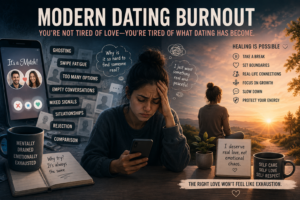
8. How to Heal Modern Dating Burnout: A Complete Guide
Recovering from Modern Dating Burnout is not about forcing yourself to date more or convincing yourself to “just stay positive.” The goal is to reduce emotional overload, understand your patterns, and rebuild a healthier relationship with intimacy.
You do not need to stop wanting love. You may simply need to change the way you pursue it.
Step 1: Take a Break—Mindfully
If dating consistently leaves you exhausted, taking a temporary break can be healthy.
A break gives you space to step away from constant swiping, messaging, rejection, and emotional uncertainty.
But there is an important difference between rest and avoidance.
- A healthy break sounds like: “I need some time to reset and understand what I actually want.”
- Avoidance sounds like: “Relationships are dangerous, so I should never get close to anyone again.”
Use the break to reconnect with yourself rather than completely withdrawing from social life.
Ask yourself: “What exactly about dating has been exhausting me?”
Step 2: Reduce Dating-App Overload
You do not have to delete every dating app forever. Instead, experiment with reducing your exposure.
Try:
- Limiting the amount of time you spend swiping
- Using one app rather than several
- Turning off unnecessary notifications
- Taking temporary breaks when you feel overwhelmed
- Prioritizing meaningful conversations over collecting matches
- Exploring opportunities to meet people offline
The goal is to make dating intentional rather than compulsive. If opening an app immediately triggers comparison, anxiety, or frustration, that may be a sign that you need less exposure—not more.
Step 3: Understand Your Attachment Patterns
Self-awareness can help you understand how you respond to intimacy and uncertainty.
You might notice:
- Anxious tendencies: overthinking messages, seeking reassurance, fearing abandonment
- Avoidant tendencies: discomfort with closeness, emotional withdrawal, strong need for independence
- Mixed or fearful-avoidant tendencies: wanting intimacy but becoming uncomfortable when it develops
These patterns are not permanent labels or diagnoses. The purpose of understanding them is to recognize your automatic reactions.
- For example: “They haven’t replied for three hours”
- might trigger: “They are losing interest. I need to do something.”
Recognizing the pattern creates a pause between the trigger and the reaction. That pause can help you respond more thoughtfully rather than automatically.
Step 4: Set Clear Dating Boundaries
Boundaries are not walls designed to keep everyone out.
They are guidelines that communicate what you are and are not willing to participate in. Some people avoid setting boundaries because they fear that being direct will make the other person leave. But someone leaving because you communicated your needs clearly may simply reveal an incompatibility.
You might say:
- “I don’t want a situationship. I’m looking for something more intentional.”
- “Prefer clear communication rather than disappearing and reappearing.”
- “Consistency is important to me.”
- “I’m not comfortable continuing without knowing what we’re looking for.”
Healthy boundaries reduce the amount of emotional energy spent trying to guess what another person wants.
Step 5: Rebuild Real-Life Social Connection
If dating has become heavily dependent on apps, reconnecting with people offline can provide a different social experience.
Consider:
- Workshops
- Clubs and hobby groups
- Volunteering
- Classes
- Community activities
- Friends-of-friends gatherings
The goal is not necessarily to find a romantic partner immediately. It is to rebuild comfortable, low-pressure human interaction.
Meeting people in environments where romance is not the immediate objective can also reduce performance pressure. You are not trying to impress someone. You are simply interacting, listening, laughing, and getting to know people.
Step 6: Slow Down the Dating Pace
Modern dating can encourage people to move quickly from matching to messaging, emotional disclosure, physical intimacy, and relationship expectations. There is nothing inherently wrong with moving quickly when both people genuinely want it. But if rapid emotional involvement repeatedly leaves you overwhelmed, slowing down can help.
Focus on:
- Having meaningful conversations
- Understanding each other’s values
- Observing consistency over time
- Discussing relationship expectations
- Building trust gradually
- Allowing emotional intimacy to develop naturally
Chemistry can happen quickly. Trust usually takes longer.
Learning to distinguish the two can protect you from becoming emotionally invested before you know whether the relationship is actually compatible.
Step 7: Create Boundaries With Social Media
If relationship content constantly makes you question your own romantic life, your social-media environment may need adjustment.
You can:
- Mute relationship accounts that trigger comparison
- Unfollow accounts promoting unrealistic relationship standards
- Reduce exposure to “perfect couple” content
- Avoid consuming endless relationship advice
- Take occasional social-media breaks
The goal is not to avoid every romantic post. It is to stop allowing curated online relationships to become the standard against which you judge your own life.
Remind yourself: You are seeing someone’s content, not their complete relationship.
Step 8: Focus on Personal Growth and Emotional Well-Being
Dating becomes harder when your entire sense of fulfillment depends on whether someone chooses you. Building a satisfying life outside romance can reduce that pressure.
Consider:
- Journaling
- Therapy or counseling when appropriate
- Exercise and healthy routines
- Developing hobbies
- Career or academic goals
- Spending time with friends and family
- Practicing emotional regulation
- Strengthening self-esteem
The goal is not to become “perfect” before entering a relationship. It is to develop a life in which a relationship becomes part of your well-being rather than the sole source of it.
A healthier mindset is: “I want a relationship, but I don’t need to abandon myself to have one.”
When Professional Support May Help
Sometimes Modern Dating Burnout is connected to deeper experiences such as unresolved relationship trauma, persistent anxiety, depression, severe rejection sensitivity, or longstanding difficulties with trust and intimacy.
If romantic stress is significantly affecting your sleep, appetite, mood, work, studies, self-esteem, or everyday functioning, talking with a qualified mental-health professional may be helpful.
Therapy can provide a space to explore:
- Repeated relationship patterns
- Attachment-related difficulties
- Fear of vulnerability
- Negative beliefs about self-worth
- Unresolved experiences from previous relationships
- Unhelpful cognitive patterns
The purpose is not to teach someone how to “find a partner.”
It is to help them develop a healthier relationship with themselves, intimacy, boundaries, and emotional vulnerability. Ultimately, healing from Modern Dating Burnout does not mean becoming less emotional or caring less about love.
It means learning how to pursue connection without repeatedly sacrificing your emotional well-being in the process.

What Future Relationships Will Look Like for Gen Z
Gen Z is not losing interest in love—they are redefining it.
Future relationships may focus on:
- Healthy Communication: More direct and emotionally aware conversations.
- Boundaries and Self-Respect: Less chasing, more clarity.
- Slow, Intentional Dating: Quality over quantity.
- Mutual Growth: Relationships as teamwork rather than dependency.
- Digital Minimalism: Less swiping, more real human connection.
Conclusion: Romance Isn’t Dead — It’s Transforming
Gen Z isn’t tired of love. They’re tired of:
- Emotional confusion
- Uncertainty
- Ghosting
- Performance pressure
- Casual culture
- Unrealistic expectations
Modern dating burnout is not a sign of hopelessness—it’s a sign that young people crave deeper, more meaningful, more emotionally safe relationships.
Healing begins when we understand the psychological causes, slow down, and choose intentional love over chaotic dating culture.
Gen Z is not anti-romance.
They’re just choosing themselves first—and that might be the healthiest start to real love.
Reference
-
American Psychological Association (APA) – Research on social comparison & rejection
https://www.apa.org -
Pew Research Center – Statistics on dating apps & Gen Z relationships
https://www.pewresearch.org -
Harvard Health – Digital stress and mental exhaustion research
https://www.health.harvard.edu -
Cleveland Clinic – Relationship stress & mental health
https://my.clevelandclinic.org -
Soft Launch vs Hard Launch Relationships: The Psychology Behind It
- Contact Us