
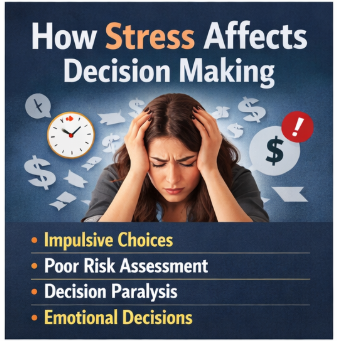
When stress takes over, your choices aren’t weak—they’re your brain trying to survive.
Introduction
In today’s fast-paced world, stress has become an unavoidable part of life. Whether it stems from work pressure, financial instability, relationship conflicts, or personal expectations, It influences not only our emotional well-being but also our cognitive functioning. One of the most critical areas affected by stress is decision making.
Every day, we make countless decisions—some small and automatic, others complex and life-changing. But have you ever noticed how your choices change when you’re stressed? You might become impulsive, overly cautious, confused, or even avoid decisions altogether. This is not accidental—stress directly alters how the brain processes information and evaluates outcomes.
This article explores how stress affects decision making from a psychological and neurobiological perspective, supported by research, real-life examples, and practical insights.
Understanding Stress: A Brief Overview
Stress is a psychological and physiological response to perceived threats or challenges. It activates the body’s fight-or-flight response, releasing hormones such as cortisol and adrenaline.
There are two main types of stress:
- Acute stress: Short-term stress (e.g., before an exam or interview)
- Chronic stress: Long-term, ongoing stress (e.g., job dissatisfaction, toxic relationships)
While moderate stress can sometimes enhance performance, excessive or prolonged stress negatively impacts cognition—especially decision making.
The Science Behind Stress and the Brain
To understand how stress affects decision making, we must look at how it influences the brain:
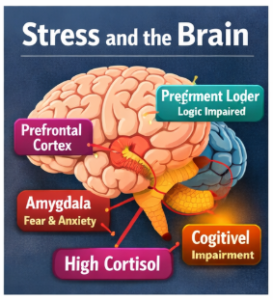
1. Prefrontal Cortex Suppression
The prefrontal cortex (PFC) is responsible for rational thinking, planning, and decision making. Under stress:
- PFC activity decreases
- Logical reasoning becomes impaired
- Emotional responses dominate
2. Amygdala Activation
The amygdala, responsible for fear and emotional reactions, becomes overactive during stress. This leads to:
- Increased anxiety
- Heightened threat perception
- Emotional decision-making
3. Cortisol Overload
High levels of cortisol:
- Reduce memory recall
- Impair attention and concentration
- Increase cognitive bias
Key Ways Stress Affects Decision Making
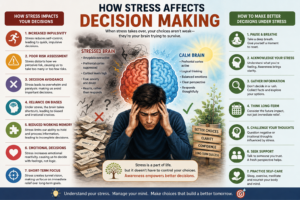
1. Increased Impulsivity
Under stress, individuals are more likely to make quick, impulsive decisions rather than carefully evaluating options. Example: A stressed employee may quit a job abruptly without considering long-term consequences.
Why it happens:
- Reduced prefrontal cortex control
- Desire for immediate relief
2. Poor Risk Assessment
Stress distorts how we perceive risk. People may either:
- Take excessive risks, or
- Become overly cautious
Example: Someone under financial stress may invest in risky schemes or avoid necessary investments entirely.
3. Decision Avoidance
Stress can lead to decision paralysis, where individuals avoid making decisions altogether. Example: A student overwhelmed by academic pressure may delay choosing a career path.
Psychological Explanation:
- Fear of failure increases
- Cognitive overload reduces clarity
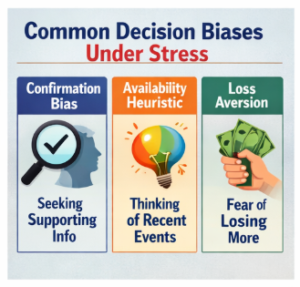
4. Reliance on Cognitive Biases
Under stress, the brain takes shortcuts (heuristics), leading to biased decisions:
- Confirmation bias: Seeking information that supports existing beliefs
- Availability heuristic: Overestimating recent or memorable events
- Loss aversion: Avoiding losses more strongly than pursuing gains
5. Reduced Working Memory
Stress limits the brain’s ability to hold and process information.
Impact:
- Difficulty comparing options
- Forgetting important details
- Making incomplete decisions
6. Emotional Decision Making
It increases emotional reactivity, leading to decisions based on feelings rather than logic. Example: Responding angrily in a conflict instead of resolving it calmly.
7. Short-Term Focus (Tunnel Vision)
It narrows attention to immediate concerns, ignoring long-term consequences. Example: Choosing instant gratification (e.g., spending money impulsively) rather than saving for the future.
Real-Life Situations Where Stress Impacts Decisions
Workplace Decisions
- Poor judgment under deadlines
- Conflict escalation
- Burnout leading to resignation
Relationships
- Miscommunication
- Emotional reactions
- Breakups driven by temporary
Financial Decisions
- Impulsive spending
- Risky investments
- Avoidance of financial planning
Health Decisions
- Ignoring medical advice
- Emotional eating
- Substance use
Acute vs Chronic Stress: Differences in Decision Making
| Factor | Acute | Chronic |
|---|---|---|
| Duration | Short-term | Long-term |
| Effect on Decisions | Quick, reactive | Consistently impaired |
| Risk Behavior | Increased | Either increased or reduced |
| Cognitive Impact | Temporary | Long-lasting damage |
Chronic stress is particularly harmful because it rewires brain functioning over time, making poor decision patterns habitual.
Psychological Theories Explaining Stress and Decision Making
1. Dual-Process Theory: This theory suggests two systems of thinking:
- System 1: Fast, emotional, automatic
- System 2: Slow, logical, analytical
Stress shifts dominance from System 2 to System 1, leading to irrational decisions.
2. Cognitive Load Theory: Stress increases mental load, leaving fewer cognitive resources available for decision making.
3. Yerkes-Dodson Law: This principle states that:
- Moderate stress improves performance
- Too little or too much stress reduces performance
Long-Term Consequences of Stress-Based Decisions
When stress consistently influences decisions, it can lead to:
- Career instability
- Financial problems
- Relationship breakdowns
- Poor mental health outcomes (anxiety, depression)
- Reduced self-confidence
Over time, individuals may develop a pattern of maladaptive decision making, reinforcing stress itself.
How to Improve Decision Making Under Stress
1. Pause Before Deciding: Taking even a few minutes can reduce impulsivity. Tip: Use the “10-minute rule” before making important decisions.
2. Practice Emotional Regulation: Techniques such as:
- Deep breathing
- Mindfulness
- Grounding exercises
- help calm the amygdala and restore rational thinking.
3. Break Decisions into Smaller Steps: Large decisions become manageable when divided into smaller parts.
4. Use Structured Decision-Making Tools
- Pros and cons list
- Decision matrix
- SWOT analysis
5. Seek External Perspective: Talking to a trusted person or counselor provides clarity and reduces bias.
6. Improve Sleep and Self-Care: Sleep deprivation worsens stress and cognitive functioning.
7. Limit Time Pressure: Whenever possible, avoid making important decisions under extreme deadlines.
Role of Counseling and Therapy
As a mental health professional, it is important to highlight that therapy can significantly improve decision-making abilities under stress. Approaches include:
- Cognitive Behavioral Therapy (CBT): Identifies and restructures irrational thoughts
- Mindfulness-Based Therapy: Enhances awareness and emotional control
- Stress Management Training: Builds coping strategies
Practical Exercise for Better Decisions
Try this quick technique:
STOP Method:
- S – Stop
- T – Take a breath
- O – Observe thoughts and emotions
- P – Proceed mindfully
This simple method can reduce impulsive reactions and improve clarity.
Conclusion
Stress is not just an emotional experience—it is a powerful force that shapes how we think, feel, and make decisions. From impulsivity and bias to avoidance and poor risk assessment, it can significantly impair judgment.
However, the good news is that decision making under stress can be improved. By understanding the psychological mechanisms behind it and applying effective coping strategies, individuals can regain control over their choices.
In a world full of uncertainty, learning to make clear and balanced decisions—even under pressure—is one of the most valuable life skills.
FAQs
1. How does stress affect decision making?
It reduces rational thinking and increases emotional and impulsive decisions.
2. Can stress lead to poor decisions?
Yes, high stress impairs judgment, leading to risky or avoidant behavior.
3. Why do I make bad decisions when stressed?
Because of it reduces prefrontal cortex activity and increases emotional responses.
4. Does stress affect the brain permanently?
Chronic stress can cause long-term changes in brain functioning.
5. Can stress make you indecisive?
Yes, it often leads to decision paralysis and avoidance.
6. How can I improve decision making under stress?
Use mindfulness, structured thinking, and take time before deciding.
7. What is the role of cortisol in decision making?
Cortisol impairs memory, attention, and rational thinking.
8. Is all stress bad for decisions?
No, moderate stress can enhance performance, but excessive is harmful.
9. How does anxiety affect decision making?
It increases fear-based thinking and risk avoidance.
10. Can therapy help with decision making?
Yes, therapy improves emotional regulation and cognitive clarity
References
Arnsten, A. F. T. (2009). Stress signalling pathways that impair prefrontal cortex structure and function. Nature Reviews Neuroscience, 10(6), 410–422. https://doi.org/10.1038/nrn2648
Bechara, A., Damasio, H., Tranel, D., & Damasio, A. R. (1997). Deciding advantageously before knowing the advantageous strategy. Science, 275(5304), 1293–1295. https://doi.org/10.1126/science.275.5304.1293
Kahneman, D. (2011). Thinking, fast and slow. Farrar, Straus and Giroux.
Lupien, S. J., Maheu, F., Tu, M., Fiocco, A., & Schramek, T. E. (2007). The effects of stress and hormones on human cognition. Brain and Cognition, 65(3), 209–237. https://doi.org/10.1016/j.bandc.2007.02.007
McEwen, B. S., & Morrison, J. H. (2013). The brain on stress: Vulnerability and plasticity of the prefrontal cortex. Neuron, 79(1), 16–29. https://doi.org/10.1016/j.neuron.2013.06.028
Pabst, S., Brand, M., & Wolf, O. T. (2013). Stress effects on decision making: A review. Neuroscience & Biobehavioral Reviews, 37(8), 1228–1240. https://doi.org/10.1016/j.neubiorev.2013.04.012
Starcke, K., & Brand, M. (2012). Decision making under stress: A selective review. Neuroscience & Biobehavioral Reviews, 36(4), 1228–1248. https://doi.org/10.1016/j.neubiorev.2012.02.003
Yerkes, R. M., & Dodson, J. D. (1908). The relation of strength of stimulus to rapidity of habit formation. Journal of Comparative Neurology and Psychology, 18(5), 459–482. https://doi.org/10.1002/cne.920180503
American Psychological Association. (2020). Stress effects on the body. https://www.apa.org/topics/stress/body
Harvard Health Publishing. (2018). Understanding the stress response. https://www.health.harvard.edu/staying-healthy/understanding-the-stress-response
Monoprova Counselling (2026), “About US”,
Monoprova Counselling (2026), “Contact Us”
This article is written for knowledge purposes, aiming to help readers understand the topic better and gain useful insights for learning and awareness.
Pingback: Can Inner Peace Reduce Anxiety and Stress?