
Feeling nervous before a big moment? You’re not alone — your body is simply gearing up to perform. Learn to channel that Nervous energy into focus and confidence.
Introduction
You’re about to walk into an interview. Your heart is racing, your palms are sweaty, and your mind keeps repeating—
“What if I fail?”
Or maybe it’s the night before an exam, and despite preparation, you feel restless and uneasy.
This experience is known as anticipatory anxiety—a psychological state where the mind and body react to a future event perceived as important or uncertain.
From a clinical perspective, nervousness before important events is not a disorder. It is a normal adaptive response rooted in both cognitive and biological processes.
The Role of the Fight–Flight Response: When Nervousness Takes Over
At the core of this experience lies the fight–flight–freeze response, a survival mechanism regulated by the autonomic nervous system.
When the brain perceives a situation as threatening—whether physically or socially—the sympathetic nervous system becomes activated. This leads to:
- Increased heart rate
- Rapid breathing
- Muscle tension
- Heightened alertness
Although an exam or interview is not a real threat, the brain interprets it as a performance-based stressor, triggering the same physiological arousal.
Amygdala Activation and Emotional Processing: When Nervous Feelings Start
The amygdala, a key structure in the limbic system, plays a central role in processing fear and emotional salience.
Before important events, the amygdala:
- Detects potential risk
- Amplifies threat perception
- Activates anxiety responses
It does not effectively differentiate between physical danger and social evaluation, which is why situations like public speaking can feel overwhelming.
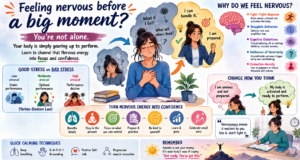
Cognitive Distortions and Catastrophic Thinking: When Nervous Thoughts Take Over
From a cognitive psychology perspective, It is often intensified by cognitive distortions, particularly:
- Catastrophizing: “If I fail, everything is ruined.”
- All-or-nothing thinking: “Either I succeed completely or I am a failure.”
- Mind reading: “They will think I’m incompetent.”
These distorted thought patterns contribute to anticipatory stress and increase emotional distress.
Intolerance of Uncertainty: When Nervousness Spikes
A major psychological factor behind nervousness is intolerance of uncertainty—the tendency to find uncertain situations stressful or unacceptable.
Because important events have unpredictable outcomes, the brain attempts to reduce uncertainty by overthinking and simulating worst-case scenarios.
This leads to heightened anxiety and mental fatigue.
Evaluation Anxiety and Social Judgment: When Nervousness Rises
Humans are inherently social beings, and our self-concept is influenced by how we believe others perceive us.
This gives rise to evaluation anxiety, also known as social evaluative threat, where individuals fear negative judgment, rejection, or embarrassment.
This is particularly evident in:
- Job interviews
- Public speaking
- Academic assessments
The perceived risk to one’s self-esteem intensifies nervousness.
Case Example: Exam Anxiety and Self-Worth
A college student experiencing severe pre-exam anxiety reported symptoms such as insomnia, restlessness, and intrusive thoughts.
On assessment, it was found that her anxiety was linked to a core belief:
“My performance determines my worth.”
This reflects a cognitive schema related to conditional self-esteem.
Through cognitive restructuring (a core technique of Cognitive Behavioral Therapy), she learned to challenge these beliefs and reduce her anxiety.
The Yerkes–Dodson Law: When Nervous Energy Helps
Not all anxiety is harmful.
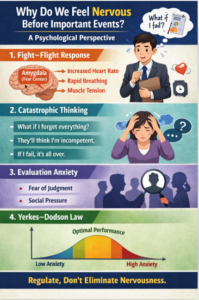
According to the Yerkes–Dodson Law, there is an optimal level of arousal for peak performance.
- Low arousal → Underperformance
- Moderate arousal → Optimal performance
- High arousal → Performance decline
This explains why a certain level of nervousness enhances:
- Focus
- Motivation
- Cognitive alertness
This type of beneficial stress is often referred to as eustress (positive stress), as opposed to distress (negative stress).
Avoidance Behavior and Anxiety Maintenance: Handling Nervous Energy
Many individuals cope with it through avoidance behavior—avoiding situations that trigger anxiety.
While this provides short-term relief, it reinforces anxiety in the long term through negative reinforcement.
For example:
- Avoiding presentations reduces immediate discomfort
- But increases fear of public speaking over time
Gradual exposure, a technique used in behavioral therapy, helps break this cycle.
Emotional Regulation and Mindfulness: Managing Nervous Feelings
Difficulty managing nervousness often reflects challenges in emotional regulation—the ability to monitor and modulate emotional responses.
Techniques such as mindfulness and grounding are effective in reducing anticipatory anxiety.
For instance:
- Focusing on breath activates the parasympathetic nervous system
- Anchoring attention in the present reduces rumination
These strategies are widely used in Acceptance and Commitment Therapy to promote psychological flexibility.
Reframing Nervousness: A Cognitive Shift
One of the most effective psychological interventions is cognitive reappraisal—changing how you interpret a situation.
Instead of labeling the experience as anxiety, it can be reframed as physiological arousal associated with readiness.
For example:
“I am anxious and not prepared.”
“My body is activated and ready to perform.”
Research shows that this shift reduces performance anxiety and improves outcomes.
Conclusion
Nervousness before important events is a complex interaction of:
- Biological activation (fight–flight response)
- Emotional processing (amygdala activation)
- Cognitive patterns (distortions and uncertainty)
- Social factors (evaluation anxiety)
It is not a sign of inadequacy, but a reflection of psychological engagement with meaningful situations.
Rather than attempting to eliminate nervousness, individuals benefit more from:
- Understanding its mechanisms
- Regulating its intensity
- Reframing its meaning
Because ultimately, the presence of nervousness often indicates that something truly matters.
Frequently Asked Questions (FAQs)
1. What is anticipatory anxiety?
Anticipatory anxiety is the fear or nervousness experienced before a future event like an exam or interview.
2. Why do we feel nervous before important events?
Because the brain perceives uncertainty and activates the fight–flight response.
3. Is nervousness before exams normal?
Yes, it is a normal and adaptive psychological response.
4. What part of the brain causes anxiety?
The amygdala plays a key role in detecting threats and triggering anxiety.
5. Can anxiety improve performance?
Yes, moderate anxiety can enhance focus and performance (Yerkes–Dodson Law).
6. What are cognitive distortions in anxiety?
They are negative thinking patterns like catastrophizing and all-or-nothing thinking.
7. How can I reduce nervousness quickly?
Use breathing exercises, grounding techniques, and cognitive reframing.
8. Why do I overthink before exams or interviews?
Due to fear of uncertainty and evaluation anxiety.
9. Can therapy help with performance anxiety?
Yes, CBT and mindfulness-based therapies are effective.
10. Is anxiety a weakness?
No. It shows that something is important to you.
References
American Psychological Association. (n.d.). Anxiety and stress response. https://www.apa.org
National Institute of Mental Health. (n.d.). Anxiety disorders. https://www.nimh.nih.gov
Monoprova Counselling, (2026), “About Us”,
Monoprova Counselling, (2026), “Contact Us”,
This article is written for knowledge purposes, aiming to help readers understand the topic better and gain useful insights for learning and awareness.